
Miss Judy Charters and Capt. Jack McGowan are holding fishing workshops in the coming weeks.
These workshops will be held at Tubby's Tankhouse in Thunderbolt on River Drive. The cost is $90 each, but breakfast and lunch are included. Capt. Jack will be holding a workshop on inshore fishing Jan. 27 from 8AM - 2PM. Capt. Judy will hold her offshore seminar on Feb. 3 from 8AM - 2PM. They will cover all the basics, then move into more advanced tips and techniques. This is a great seminar series for beginners who don't know where to start or old salts who need to brush up on the latest gear and techniques.
To sign up call 912-897-4921 or email Miss Judy at fishjudy2@aol.com .
Saturday, January 20, 2007


Tuesday, January 16, 2007
Savannah's Stripers
Savannah has one of the best striped bass fisheries that you've never heard about. Few people realize that you can catch world-class stripers within sight of downtown Savannah, but after several decades of conservation these Dixie linesiders are back in a big way. When you hear people talk about catching 30+ pound stripers, one's mind usually turns to the chilly New England surf. However, the Savannah, Forest, and Ogeechee Rivers routinely turn out monster stripers.

Stripers are, biologically, a very interesting fish. They are native to saltwater, but are highly tolerant to freshwater. So much so, that many reservoirs and lakes now have large populations of stripers that live their entire lives in freshwater. Ocean stripers live mostly in the saltwater until it is time to spawn, when they move into brackish and freshwater estuaries. Georgia's stripers, though (and those of the St. John's River in Florida) have the opposite life cycle. They live mostly upriver in freshwater during the warmer months, and then move into the brackish and saltwater in the winter.
The Savannah River estuary, from roughly the I-95 bridge all the way to Elba Island, is where you can usually find the stripers this time of year. The best spots have deep, vertical structure, which is why the two hottest spots are at the Houlihan Bridge in Port Wentworth and the old tide gates on the Back River behind Hutchinson Island. The pilings act as current breaks which the stripers can hide behind to ambush prey. Old pilings and channel markers along the Port Wentworth docks hold fish, as well as the mouths of old rice canals feeding into the Savannah Wildlife Refuge.
The Savannah River gets most of the fanfare, but the Forest River and Ogeechee also hold good populations of stripers. Again, bridge pilings and rice canal mouths are good striper-holding structure.
Fairly stout tackle is a must, because some of these fish top 50 pounds. Heavy spinning tackle with 30-50 pound braided line is the best way to go. Live bait can be a good choice depending on what's available. When stripers are feeding on the top, a shrimp under a popping cork is a treat for them. When they're on the bottom, which is where they will be most of the time, a livelined finger mullet is the way to go.
Various artificial lures will work for stripers, but perhaps the best two choices are large swimbaits or bucktail jigs.

Swimbaits are soft plastic baitfish-shaped lures that are pre-weighted and hooked. You just tie them on and cast. These are great baits when the stripers are feeding on mullet and pogies, and several companies make imitations of these baits. The new P'nut Bunker from Storm is a pogy imitation that is perfect for stripers. Keep in mind that stripers often hit big baits. Swimbaits 6 inches or larger are readily taken by even small fish. When retrieving, let the bait fall to the bottom, then retrieve it slowly, letting the current give it action. Pause periodically, letting the bait flutter down. This falling action is often what triggers the striper's instinct to feed.

Bucktail jigs are classic lures for stripers that have been used for generations. The best jigs for river fishing are in the 1/2-ounce to 2 ounce range. Large tides combined with increased flow from the dams upriver can make the current very strong in the Savannah River at times. Heavier jigs will help get the bait to the bottom. These are best pitched very tightly to structure. A jig falling vertically along a piling is almost unbearable to some stripers. The best color combos are red and white or chartreuse and white. To increase the action, pin a chartreuse grub trailer or other small soft plastic to the hook. You can also tip the hook with a small strip of mullet or piece of shrimp to sweeten the deal even more.
A good guide is a great thing to have if you want to hunt stripers, but are overwhelmed by the amount of water you need to cover. Contact Capt. Jack and he can get you on top of some of the biggest linesiders in the area.
Good luck!
Stripers are, biologically, a very interesting fish. They are native to saltwater, but are highly tolerant to freshwater. So much so, that many reservoirs and lakes now have large populations of stripers that live their entire lives in freshwater. Ocean stripers live mostly in the saltwater until it is time to spawn, when they move into brackish and freshwater estuaries. Georgia's stripers, though (and those of the St. John's River in Florida) have the opposite life cycle. They live mostly upriver in freshwater during the warmer months, and then move into the brackish and saltwater in the winter.
The Savannah River estuary, from roughly the I-95 bridge all the way to Elba Island, is where you can usually find the stripers this time of year. The best spots have deep, vertical structure, which is why the two hottest spots are at the Houlihan Bridge in Port Wentworth and the old tide gates on the Back River behind Hutchinson Island. The pilings act as current breaks which the stripers can hide behind to ambush prey. Old pilings and channel markers along the Port Wentworth docks hold fish, as well as the mouths of old rice canals feeding into the Savannah Wildlife Refuge.
The Savannah River gets most of the fanfare, but the Forest River and Ogeechee also hold good populations of stripers. Again, bridge pilings and rice canal mouths are good striper-holding structure.
Fairly stout tackle is a must, because some of these fish top 50 pounds. Heavy spinning tackle with 30-50 pound braided line is the best way to go. Live bait can be a good choice depending on what's available. When stripers are feeding on the top, a shrimp under a popping cork is a treat for them. When they're on the bottom, which is where they will be most of the time, a livelined finger mullet is the way to go.
Various artificial lures will work for stripers, but perhaps the best two choices are large swimbaits or bucktail jigs.
Swimbaits are soft plastic baitfish-shaped lures that are pre-weighted and hooked. You just tie them on and cast. These are great baits when the stripers are feeding on mullet and pogies, and several companies make imitations of these baits. The new P'nut Bunker from Storm is a pogy imitation that is perfect for stripers. Keep in mind that stripers often hit big baits. Swimbaits 6 inches or larger are readily taken by even small fish. When retrieving, let the bait fall to the bottom, then retrieve it slowly, letting the current give it action. Pause periodically, letting the bait flutter down. This falling action is often what triggers the striper's instinct to feed.
Bucktail jigs are classic lures for stripers that have been used for generations. The best jigs for river fishing are in the 1/2-ounce to 2 ounce range. Large tides combined with increased flow from the dams upriver can make the current very strong in the Savannah River at times. Heavier jigs will help get the bait to the bottom. These are best pitched very tightly to structure. A jig falling vertically along a piling is almost unbearable to some stripers. The best color combos are red and white or chartreuse and white. To increase the action, pin a chartreuse grub trailer or other small soft plastic to the hook. You can also tip the hook with a small strip of mullet or piece of shrimp to sweeten the deal even more.
A good guide is a great thing to have if you want to hunt stripers, but are overwhelmed by the amount of water you need to cover. Contact Capt. Jack and he can get you on top of some of the biggest linesiders in the area.
Good luck!
Friday, January 12, 2007
Cold Snap Heralds Bluefin Blitz
The last few years have been great seasons for Bluefin Tuna off the Georgia/SC coast. Normally, the bluefin migrate down from the huge fishing area known as the Grand Banks off New England to the Outer Banks each winter. Only a few confused loners normally make it our way. The last few years, though, the entire pod of Bluefin overshot OBX and headed down into our area. A new South Carolina state record of 396 pounds was caught last year just five miles off Hilton Head on the Betsy Ross wreck. This year appears to be shaping up the same way. Early catch reports from North Carolina suddenly ran cold in late December, and reports of the blue monsters have been coming in from this area more frequently.
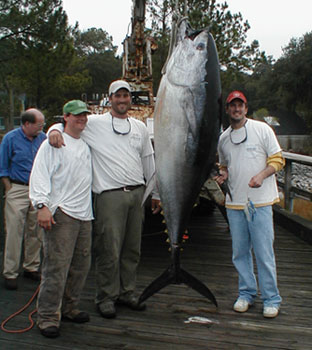
The new South Carolina Bluefin record of 396 pounds.
As recently as last weekend, large schools of bluefin were reported at some of the Georgia Naval Towers, specifically R6 and R7. If last year was any indication, the cooler the water gets, the closer in the tuna will come. The water is still relatively warm for this time of year (if you call 60 degree water warm...), so they'll probably still hang out at the towers for awhile.
When choosing tackle for these bruisers, keep in mind that they average over 100 pounds, even in this area. A metal framed 50-class reel or bigger is a must, spooled with 60-100 pound test monofilament. Anything less will simply not cut it. A big tuna can crack the frame on any cheaply made or graphite frame reel. If you want to fight it standing up, an 80-130 pound class rod is needed, the shorter the better. A 5'6" rod is normal. If using a fighting chair a longer (6'6"-7'), lighter rod is best, usually in the 50-80 pound class range.
Bluefin take both live and dead trolled baits. Big ballyhoo or bonita with colorful skirts covering the nose are great choices. When using artificials, big cedar tuna plugs are the best go-to bait, but artificial ballyhoo, bonita, or big trolling lures with chugger heads will do the trick.
When you do hook up with one, be prepared for a long battle with many runs and deep dives. Whatever you do, though, do not let the fish go too deep for too long. Bluefin often sound to the depths and die, leaving you with a couple hundred pounds of dead weight to haul straight up. It is much easier to bring a live, willing 300 pound tuna to the boat than a 100 pound dead tuna on the bottom. Also make sure to have several helping hands onboard when you bring the fish to the boat. A very heavy gaff is needed to haul a fish this size onto the boat, as well as 2-3 bodies to heave it over the gunwhales.
Bluefin fishing is not for beginners. you need an experienced captain and a good boat that can handle the rough seas this time of year. However, the effort is worth the reward, because bluefin really are the only huge pelagic species that the average Low Country day-tripper has a shot at. Marlin, sailfish, and wahoo confine themselves to the Gulfstream waters for the most part, but you can be tangling with a 300+ pound tuna only a few minutes offshore!
Wednesday, December 27, 2006
Near-Shore Wreck Season
'Tis the season to hit the near-shore wrecks in search of black sea bass and sheepshead. The seas have been a bit rough, but on calm days boats are reporting great catches of blacks. One guy told me they used 4-hook bottom rigs and hooked up on all 4 on nearly every drop.

The artificial reefs, especially at the "J" and "L" buoys, seem to be producing nicely, but Gray's Reef seems to be the best bet at the moment. The best rig is a multiple-hook bottom rig with either gold or silver hooks in the 2/0-4/0 range. Good baits for sea bass include squid, large shrimp and cut sardines or mullet. However, black sea bass aren't exactly known to be picky, so just send down a hunk of meat and you should hook up with something.
What is known to be picky, however, is sheepshead. Catch reports for these bait-stealers have been a bit slow, but that is probably due to the warmer-than-usual weather. The reports, have been getting better recently, and should continue to as the typical nasty January/February weather rolls in. Fiddlers will be the best bait, but small peeled shrimp will also work. Use a knocker rig (aka Carolina rig or egg sinker rig) with a long-shank, small-gap Mustad hook.
On the inshore front, seatrout catches are still strong, but starting to slow. Trout and sheepshead are really the only things worth tareting inshore right now.
Bonefish Grill Review
I had a chance to try out the new Bonefish Grill in Twelve Oaks in Savannah, and I am very impressed. The atmosphere and food were all great, and despite the place being packed to the walls, our service was awesome and quick. It is a little expensive, but you definately get what you pay for. Be sure to try the mussels!
Thursday, December 21, 2006
Back From Hiatus
After a long vacation, the Low Country Angler is back to provide you with up-to-date reports, coming soon.
P.S.- The trout bite has been so hot it's been hard to post here. It is still hot, having caught a limit of trout this weekend, all over 18 inches!
P.S.- The trout bite has been so hot it's been hard to post here. It is still hot, having caught a limit of trout this weekend, all over 18 inches!
Wednesday, October 11, 2006
Huge Shark Catch + Fall Bass Hunt
Huge Tiger Shark Caught in Broad River
We heard this week of an amazing catch on October 5th in the Broad River near Beaufort. A local was fishing with his family at a deep spot known as the "Cobia Hole" near the Broad River bridge. Fishing on bottom with heavy tackle hoping to catch a respectable-sized shark, he got more than he bargained for. After a surprisingly short, but intense battle, he brought a 12 and 1/2 foot tiger shark to the boat. Being so large, there was no way to get the shark into his bay boat, so he towed it to shore to measure and clean it. After adding up the weight of the meat cleaned off, plus the rest of the carcass, it is estimated at near 700 pounds. While a huge shark, amazingly it is over 1,000 pounds lighter than the SC state record (and one-time world record), a 1,780 pound behemouth hauled in at Cherry Grove in 1964.

The story of that world record is an amazing one, not just for the size, but how it was caught. Walter Maxwell was fishing on a hot mid-June morning in Cherry Grove, and he was rigged up for big sharks. Using 130-pound line on a 16/0 Penn reel, Walter hooked up with that monster not from a boat, but from the pier. As crowds of onlookers gathered, he battled the shark up and down the boards for hours, eventually bringing the giant onto the beach. When it was beached it probably weighed over 2,000 pounds, but it wasn't weighed until hours later when it was trucked to a scale large enough to weigh it. In that time it lost a lot of weight from dehydration. However, even that couldn't keep it from going down in the records as the largest tiger shark ever caught until it was broken in 2004 on Australia's Great Barrier Reef.
Fall Bass Hunt
Fishing for largemouth bass in the fall can be hit-and-miss. Bass become much more picky in their eating habits as the water starts to cool, and many factors weigh into the feeding patterns. Weather is the single biggest factor at play in the fall, and success depends on cold fronts, cloud cover, air temperature, water temperature, rainfall, and water clarity. The best time to fish is the short period before a cold front moves through when there is good cloudcover, but the temperatures have not dropped a lot yet. Fish are cold-blooded, meaning that they need to feed aggressively while it is warmer so they can stock up on calories for when colder temps make the fish sluggish. This is especially true of big bass, who need to feed like a bear that's about to go into hibernation.
Good baits this time of year are baitfish imitations, like flukes or spinnerbaits. Cooler temperatures mean you should slow down your presentation a little bit to accomidate for slower fish. A pig-and-jig combination is also a good choice. In a black/blue color, it is great flipped around structure like submerged timber, docks, and river bluffs.
After a front moves through, bluebird skies and frigid air usually mean the bass bite will nearly shut off all together. However, if you absolutely must go fishing, suspending or sinking stick baits like a Smithwick Rogue work very well fished slowly at deeper depths, where the bass are hunkered down.
We heard this week of an amazing catch on October 5th in the Broad River near Beaufort. A local was fishing with his family at a deep spot known as the "Cobia Hole" near the Broad River bridge. Fishing on bottom with heavy tackle hoping to catch a respectable-sized shark, he got more than he bargained for. After a surprisingly short, but intense battle, he brought a 12 and 1/2 foot tiger shark to the boat. Being so large, there was no way to get the shark into his bay boat, so he towed it to shore to measure and clean it. After adding up the weight of the meat cleaned off, plus the rest of the carcass, it is estimated at near 700 pounds. While a huge shark, amazingly it is over 1,000 pounds lighter than the SC state record (and one-time world record), a 1,780 pound behemouth hauled in at Cherry Grove in 1964.
The story of that world record is an amazing one, not just for the size, but how it was caught. Walter Maxwell was fishing on a hot mid-June morning in Cherry Grove, and he was rigged up for big sharks. Using 130-pound line on a 16/0 Penn reel, Walter hooked up with that monster not from a boat, but from the pier. As crowds of onlookers gathered, he battled the shark up and down the boards for hours, eventually bringing the giant onto the beach. When it was beached it probably weighed over 2,000 pounds, but it wasn't weighed until hours later when it was trucked to a scale large enough to weigh it. In that time it lost a lot of weight from dehydration. However, even that couldn't keep it from going down in the records as the largest tiger shark ever caught until it was broken in 2004 on Australia's Great Barrier Reef.
Fall Bass Hunt
Fishing for largemouth bass in the fall can be hit-and-miss. Bass become much more picky in their eating habits as the water starts to cool, and many factors weigh into the feeding patterns. Weather is the single biggest factor at play in the fall, and success depends on cold fronts, cloud cover, air temperature, water temperature, rainfall, and water clarity. The best time to fish is the short period before a cold front moves through when there is good cloudcover, but the temperatures have not dropped a lot yet. Fish are cold-blooded, meaning that they need to feed aggressively while it is warmer so they can stock up on calories for when colder temps make the fish sluggish. This is especially true of big bass, who need to feed like a bear that's about to go into hibernation.
Good baits this time of year are baitfish imitations, like flukes or spinnerbaits. Cooler temperatures mean you should slow down your presentation a little bit to accomidate for slower fish. A pig-and-jig combination is also a good choice. In a black/blue color, it is great flipped around structure like submerged timber, docks, and river bluffs.
After a front moves through, bluebird skies and frigid air usually mean the bass bite will nearly shut off all together. However, if you absolutely must go fishing, suspending or sinking stick baits like a Smithwick Rogue work very well fished slowly at deeper depths, where the bass are hunkered down.
Monday, October 09, 2006
Flood Tide Quandary

A full moon, combined with a low-pressure system moving over the area, has pushed the tides to very high levels over the South Carolina and Georgia coasts. Such tides muddy the water and turn normally placid creeks into whitewater rapids on the tide changes. They also push the bait and fish high into the spartina grass at high tide. Needless to say, this creates a hostile fishing environment for the average angler.
Time to leave the rods in the garage, right? Actually, the flood tides present a unique opportunity for the angler in-the-know. South Carolina, and particularly Georgia, lack the traditional salt "flats" typical of Florida and the Gulf Coast. While fishing on the bottom at low tide in the deeper sounds and on the beaches might net you some success in such big tides, it's fishing the skinny water that really gets exciting when the tides get high. Florida anglers boast tales of "tailing" redfish and sight fishing for seatrout on shallow-water flats, and flood tides give Low Country anglers a shot at the same type of action.
Fishing such high tides means special tactics, meaning that you'll either need a shallow-draft flats boat or go wade fishing. Due to the fact these big tides can change in a hurry, leaving even a flats boat high and dry, I recommend the latter. Flats fishing is done strictly with either artificials on spinning or light baitcasting equipment or with a fly rod. I recommend using waders with flats boots to avoid nasty oyster and sawgrass cuts.
When using artificials, a medium-light saltwater spinning reel, such as a Daiwa Capricorn, is best mounted on a 7 to 7 1/2 inch, medium-heavy, extra-fast action rod. I recommend the Shimano Teramar series of rods due to their light weight, but high strength (the over-the-counter lifetime warranty helps, too). Saltwater-ready baitcasters like the Shimano Curado work well on a 7-foot casting rod of the same action.
There are several different artificial baits to try in the grass, and a good selection of each is key to finding what the fish are biting on. However, all baits need to be somewhat weedless in order to slip through the thick grass. Gold Johnson spoons are a good choice, as are redfish spinnerbaits like the Thunder Spin in the Calcasieu color. A 5-inch Saltwater Assassin rigged weedless with an offset worm hook slips through the grass well, and draws hard stikes from tailing spottail bass. If you find an area with less grass, topwaters like a Rapala SkitterWalk or a Mirrolure work well.
 If using fly tackle, which is a great option on a flood tide, a 7-8 weight rod is best with weight-forward floating line. Clouser flies, as well as shrimp and crab imitations like a Redfish Ration are great choices. Stained water means that sight fishing isn't as great as in Florida, but casting ahead of wakes and rustling grass can put you on some fish. The greatest thrill of all is watching a redfish barrel through the grass to attack your fly!
Fishing these flood tides can be very tricky and intimidating, but with the right setup and the right location, you can get into plenty of inshore action while everyone else is waiting to put their boat back in the water.
Tuesday, October 03, 2006
Fall Fishing Blitz
The fall inshore fishing season has begun with a bang. Though temperatures have barely dropped, the fish don't seem to care as the usual fall run of seatrout and redfish has begun early and strong. Limit catches of large seatrout and runs of big bull redfish have been reported the last couple of weeks, and it only seems to be getting better.
Surf Fishing Class
On Thursday, October 12 at 6:30 PM there will be a class on fall surf fishing for red drum on the Georgia/South Carolina coast at the Savannah Bass Pro Shops. They'll be covering tackle, casting techniques, bait, and more. Please sign up by email or in person at the Customer Service desk at Bass Pro.
Seatrout Hawgs

One of the most impressive things about the seatrout catch reports is the size of many of the trout being caught. While large numbers of trout were biting all summer, few were large enough to keep. Now some of the trout are falling into the "gator" category. One recent report was of a limit catch in Ossabaw Sound that included 6 trout over 20 inches! Catches like that are common in Florida and on the Texas coast, but they are a rare occurance in Georgia or the Carolinas.
Red Bullys
Fall bull redfish have arrived on the beaches and whether you're surf fishing or anchored on a boat on the outside of the sounds, you should have a good chance this year at catching a nice red drum. Bait of choice is a mullet, a small blue crab, or a half-crab fished on the bottom. Make sure you have a reel with a lot of line, becuase in most cases these redfish are 40+ inches and topping 30 pounds.
Saltwater Outlook
A stretch of spring tides at the end of the week might slow the fishing for a little while, but then as the temperatures cool down the fishing should heat up on the coast by mid-next week.
Thursday, September 28, 2006
First Annual Georgia Redfish Rally

Get Ready!! The Nesmith Chevrolet Georgia Redfish Rally 2006 will be kicking off on October 1. Georgia's first state wide "redfish with the most spots" tournament will begin October 1 and will run through November 15, 2006. Registration will begin September 1 and anyone who registers before September 21 will recieve a special "early bird" price. Registration will be available through mail in registration forms, at official registration sites coastwide in Georgia, and online at www.ccaga.org. For a list of available registation and count-in sites please view them online or on the registration forms.
During the Nesmith Chevrolet Georgia Redfish Rally 2006, registered anglers can bring legal red drum to official "count in stations" located coastwide in Georgia for a chance to win over $45,000 in prizes. Catch the redfish with the most spots, take it to an official "count in station", and win a new truck, a new boat, or a new golf cart!
Rally proceeds will benefit the American Diabetes Association and the Peach State Reds Initiative. The mission of American Diabetes Association is to prevent and cure diabetes and to improve the lives of 20 million Americans who have diabetes. The Peach State Reds Initiative represents a joint venture of CCA-GA, the Georgia Department of Natural Resources, the Florida Fish and Wildlife Conservation Commission, the South Carolina Department of Natural Resources and the University System of Georgia. Through the initiative, scientists will spawn Georgia redfish in captivity and release fingerlings into Wassaw Sound and a saltwater impoundment on Jekyll Island to study the efficacy of stock enhancement.
For a complete listing of all rules, regulations, prizes, registration sites, and official count in stations, please view this website or the mail in registration forms distributed state wide.
Wednesday, May 24, 2006
Catch More Dolphin

Want the chance to catch one of the best pelagic gamefish in the world, the dolphin, a.k.a. dorado, a.k.a. mahi-mahi?
Now is your chance, with reports coming in from the western edge of the Gulfstream of epic catches of big dolphin. These are no schoolies. One angler who was fishing a weedline a couple miles past the South Ledge reported filling the boat's fishbox in minutes with 10-25 pounders. Rising water temperatures mean that big bulls aren't too far behind. Ledges like the Deli, the Triple Ledges, South Ledge, the Hump, all are holding scores of dolphin at this time.
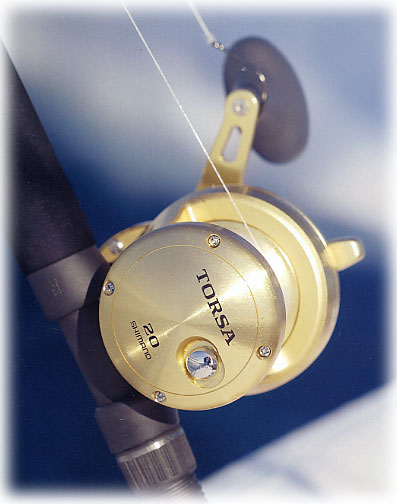
To gear up for dolphin, first you'll need a boat that can make the often-choppy 50-80 mile trek from the Low Country coast to the Gulfstream. In July through September the water warms enough that the dolphin move in closer, usually into around 100-150 feet of water, but until then they stay within the Gulfstream. 25-50 pound conventional or 20-40 pound spinning tackle is necessary, as even a small dolphin can put up a titanic fight. Good conventional reels include the Shimano TLD series for standard trolling, but if you want to go high-end, try either the Shimano Trinidad or Torsa reels, both of which are great for chunking and casting to dolphin, and feature heavy drags for their small physical size. If you like spinning tackle, which helps if you're doing casting in the wind, the Shimano Baitrunner or Quantum Cabo reels spooled with 50-65lb braided line are good choices. As for rods, you'll want a medium-heavy to heavy power rod with a fast action, meaning the tip has a good flex but the blank is stiff near the handle.
Trolling is the main way to target dolphin. The standard trolling speed is around 7 knots, usually in a waving, or zig-zag pattern. If you can locate a weedline, eddy, or a change of water color, use this trolling pattern parallel to these points of interest, which usually hold dolphin cruising beneath the surface. If these points of concentration can't be located, try locating a ledge or livebottom, and run the zig-zag pattern down its length.
Live or frozen baits are best trolled on a wire leader complemented with a flashy, colorful artifical lure. Rattle-Jets, Islanders, and squid skirts are all good additions to a rigged bait, usually either a ballyhoo or cigar minnow. The best colors are usually chartreuse or pink, but sometimes they will key in on another certain color for some reason. Teasers or teaser dredges are good too use as well, though they seem to attract more of the small "schoolie" dolphin then the big bulls.
When you get a hookup with a dolphin, its always wise to take your time with the fish, and even leave it in the water with the drag fairly loose for awhile. The reasoning behind this is that other dolphin will try to school up with the fish you're hooked into, increasing the chance of getting more hits on other baits.

Remember when boating your dolphin, though, that these delicious fish have lots of meat on them, and unless you plan on selling your fish at market, just one or two fish will easily feed a whole family with leftovers to freeze, so take only what need.
Friday, May 19, 2006
Go Fishing!
Its that time of year, after the cool spring days and just before the dog days of summer when it's truly a mixed bag on the Low Country coast. I've been slack in posting lately because I've been too busy -what else- fishing! Saltwater inshore is teeming with seatrout, redfish, cobia, flounder, sheepshead and more, while offshore the snapper and grouper are biting on bottom and kings, wahoo, and dolphin are heating up on top. Soon tarpon will be rolling into the area sounds and inlets as well. In freshwater the shellcrackers, redbreast, and bluegill are biting, along with big catfish in the Altamaha River and Santee-Cooper lakes. Bass are biting well across the area, too.
So what are you waiting for? Get out there like I've been doing, and have some fun! Take your family or at least your kids and share your love of fishing. When I get a chance I'll be back to fill you in on the fishing outlook, as well as the story of my huge ladyfish caught off the beach, with pics!
So what are you waiting for? Get out there like I've been doing, and have some fun! Take your family or at least your kids and share your love of fishing. When I get a chance I'll be back to fill you in on the fishing outlook, as well as the story of my huge ladyfish caught off the beach, with pics!
Saturday, May 06, 2006
Fishing Outlook
Cobia Main Event
The annual run of cobia in the Broad River/Port Royal Sound has begun, as reports of lings ranging from 30 to 80 pounds have been coming in. The action will be centered around the Beaufort area, but thats not the only place you''l find them. They should be fairly easy to find in the Georgia sounds and nearshore wrecks, and are moving their way up the Carolina coastline towards Charleston as we speak.
When fishing inshore for these big suckers, fishing on bottom in deep holes that run out into deeper channels is a good bet. Use live or fresh-dead menhaden or eels with a "fishfinder" (i.e. slipsinker) rig. However, if you want the action of sight fishing, search channel markers, bridge pilings, sea turtles, big rays, etc. If you see one, try casting a big tube or artificial worm (a 10 or 12 inch worm works great as an eel imitation), or also a bucktail jig. Try to anticipate where he's going when you make your cast, as you want to bring the bait a few feet in front of his nose.
Inshore Outlook
The tides aren't very big for the next few days, so the water will be a little sluggish and that tends to make inshore fish on the Low Country coast a little skittish. Your best bet will be to find a river inlet or slough that has some brisk current to keep the baitfish, and the predators, active. Sunday and Monday will bring some thunderstorms as a light front moves through, that the chance of storms increases again on Wednesday and Thursday. Fishin just before and after a storm comes through is usually hot, but be cautious when dealing with lightning.
Offshore Forecast
Winds and seas will remain quite moderate until late next week, though conditions will get rough in and around thunderstorms.
Steve Rashke of Bass Pro Savannah reported trolling the R6 tower on Thursday and landing 14 kings, including one 25 pounder. The water temperatures are just about reaching the point where the kingfish will really start to invade area waters.
Bottom fishing is still getting into high gear with quite a few more reports of big snapper and a few grouper coming in. As the weeks progress, expect more brown color to be added to the red hue of the bttom fishing reports.
The GulfStream wahoo action has been very hot lately, too, with several reports of trashed tackle due to these violent rig-choppers.
Thursday, May 04, 2006
Bottom Fishing Report 4/3
After a week of watching the marine forecast and crossing our fingers, we were able to take a trip to the Savannah Snapper Banks yesterday with Captain Johnny Fulcher of Amick's Charters aboard the Scamp. The boat, which handles smaller trips than Steve Amick's big Scat II, just had a new engine installed that tops the boat out at over 30 knots. While choppy 3-5 foot seas kept us from reaching that speed, the maiden voyage of the Scamp was very quick, getting to and from the Snapper Banks in about 2 hours.
Cpt. Johnny put us on the spot and our 5-man group quickly limited out on beeliners. We got 4 good red snappers, including one in the 15-pound range, and a couple of keeper scamps. I caught one gag grouper which was barely undersized, but the law's the law. Other catches included some big black sea bass and triggerfish. One common pattern on the southeast Atlantic coast is that sharks become highly active after a period of blustery conditions. This was the case again yesterday, as we caught about 10 reef sharks, each causing fishing to stop for awhile as the shark circled, tangling lines. At one point a shark tangled the lines of every angler on the boat!
Despite shark troubles, it was a great day and the conditions smoothed out as it went along. The only bad part was the 50 pounds of fish I cleaned when I got home! Pictures of the trip coming soon.
Saturday, April 29, 2006
Cobia Arrival

Apparently the cobia have finally moved into the area, being caught in Wassaw Sound in Georgia and Port Royal Sound/Broad River South Carolina. The above 50-60 pounder was caught in Port Royal Sound according to a post on the SavannahNow Forums. Bait of choice was dead menhaden (pogy).
Seatrout Mamas
The inshore locals have been dominated by reports of large seatrout, some greater than 20 inches. These roe trout have been rather fat as well. I have to stress that it is very important that you carefully handle and release the largest and healthiest of these female seatrout. They are the ones who will spawn and have offspring that are more likely to grow to large sizes as well.
Snapper Time
I"ve got some more info on the recent trip some friends of mine took with Captain Steve Amick. They visited the Savannah Snapper Banks and limited out on vermillion (beeliner) snapper almost immediately. In addition, they caught several scamp grouper, some huge black seabass (the biggest catch of large seabass I've ever seen...), and several keeper red snapper and grouper, including one 17-pound red snapper. All in all, they had a great time and the haul totaled over 400 pounds, which Cpt. Amick declared the largest catch so far this year.
Offshore Forecast
The chances of anyone getting offshore until at least Wednesday are almost 0, with gale winds throughout the period whipping up some monster wave action. A semi-cyclonic low pressure system spawned off the recent cold front has moved into place offshore of the Carolinas and Georgia, and is forecast to sit there for the next few days. There is even a chance that it might take on tropical characteristics and become a tropical depression before the hurricane season even begins. Needless to say, this front will prevent pretty much any offshore fishing until mid-next week.
Inshore Forecast
Anyone thinking of fishing in the sounds or beachfronts this week needs to think again. High surf warnings are posted up and down the coast, meaning that any safe fishing will be done in protected areas higher up in the creeks and rivers. Tides are returning back to good levels, but the onshore winds are likely to make tides a little higher than they are forecast. This could mean that trout and redfish will try to bury themselves in the sheltered marshgrass at high tide, so those with low-draft skiffs might be in luck if they work the shallow water holes in the marshgrass. The backsides of barrier and inshore islands will not only offer protection from the wind, but will give you a better chance at landing some of the big trout available.
Freshwater Forecast
Sometimes it's nice to be a freshwater fisherman because you don't have to worry quite as much about things like high seas and gale winds. In fact, wind and choppy water can sometimes add up to great bass fishing. Before the last cold front went through, I was fishing a local pond right as a squall line was approaching. The bass bite suddenly turned on and I caught 3 good fish, one approaching 5 pounds. The next day I returned and the wind was howling following the front. I Texas-rigged a black Culprit worm with a 1/8 ounce worm weight and swam the worm briskly across the bottom. I caught 4 good fish within the space of 30 minutes, including one approaching 6 pounds. Just goes to show you that just because the conditions aren't comfortable for you doesn't mean that the fish isn't comfortable.
Tuesday, April 25, 2006
Daffin Park Pond Deathtrap
Something that has concerned me for the last few months has finally come to a head.
The pond in Savannah's Daffin Park has been a marvel for such a small, urban environment. Over the years it has had an amazing population of largemouth bass, catfish, bluegill, and carp. Most people ride by it every day and don't realize that there are fish in it.
However, last year alone I caught and released many bass in the 2-4 pound range and 2 which were 6+ pounds. I'd seen bass in the lake that easily would be larger than 8 pounds. In fact, a friend has told me of the time when they drained the lake to build the Daffin Park pool, only to find a 17 pound largemouth in the bottom of the dried-up pond.
This year, starting when we had a warm spell in February, an algae bloom in the pond began to spread, turning the water a blue/green color and filling the edges with green scum. In March, I began my weekly ritual of stalking the banks looking for bass beginning to make their beds. I began to be troubled by the fact that I couldn't find any of the larger bass anymore, and the area by the old fishing dock on the east end of the pond was filled in with algae, and had pushed out the family of huge German carp that normally lived there. The algae not only pushes out fish, but it sucks all of the oxygen out of the pond, slowly suffocating the fish population.
Week after week, I've returned to find dead bluegill and catfish floating at the edge of the pond, and no sign of the bass. Today I saw something that finally has pushed me into action. I arrived to find that the recent heat wave has pushed the algae bloom into high gear, with giant mats of slime covering large portions of the pond. As a walked the pond edge, something caught my eye on the north bank by Victory Drive. There, floating in the scum, was a huge dead largemouth bass, easily 7-8 pounds, baking in the sun. I ran and grabbed my camera from the car and started documenting this horror.


The family of large carp that inhabits the pond is nowhere to be seen, either. The pond is filling up with the stuff, which can be easily prevented and destroyed with water additives.
While I was stalking the lake and taking pictures, a gentleman on a bench asked me if I worked for Tree and Park Services. We struck up a conversation about the problem, and he commented that, "The only way we'll stop this from killing off the lake is if we get the community involved."
I have forwarded this story and pictures to the Savannah Morning News and Savannah Tree and Park to hopefully get things moving quickly.
Monday, April 24, 2006
Weekend Wrap-Up
Surf Heating Up
The surf fishing front has been improving day-by-day, with great catches of whiting, trout, and good keeper-sized bluefish. I visited the Tybee pier Friday and quickly filled up a cooler with 2 dozen good-sized whiting and a dozen blues well above the 12" size limit. Everyone at the pier was catching something, which is always a good sign.
Inshore
Reports of large trout catches were coming in heading into the weekend, but big spring tides have the fish turned off for the past few days. Redfish and sheepshead were also still biting fairly well.
Offshore Mixed Bag
A combination of strange water temperatures and cold fronts have made the fishing offshore up and down recently. A captain out of Hilton Head headed to the Gulf Stream last week to look for dolphin and perhaps some sails or wahoo and found a monster rip 80 miles off where the surface temperature jumped from 69 degrees to 76 degrees in less than 200 yards. Strangely enough, a large school of dolphin was on the cold side of the rip and they caught a limit quickly, with several over 10 pounds.
A Savannah bottom fishing captain reported that despite daytime highs on land in the 80s, the surface temperature at the Snapper Banks was still only in the low 60s, making a trip there quite cool. The average catch had been a lot of beeliners and seabass, with few, if any, keeper snapper or grouper. However, this Monday that same boat returned with a much more promising catch totalling nearly 500 pounds, with one 20-pound red snapper. Hopefully this means things are changing and the fish are beginning to stir.
Lake Mayer Woes
Some friends and I were involved in an unofficial bass tournament at Lake Mayer in Savannah on Sunday, and you couldn't buy a fish if you wanted to. A combination of perhaps the large Sunday crowd, a front that had just moved through, and bluebird skies gave the fish lockjaw. After 2 1/2 hours of fishing we were afraid we would be completely skunked when one guy finally caught the trophy 1-pounder right at sunset. Lake Mayer has always been a difficult lake to fish, but Sunday was the worst I've seen it.
Prerigged Shrimp Lure Comparison
(Click on image for link)
#4: Creme Jerk n'Shrimp- This shrimp lure is a bit different from the rest in that it is a hardbait, not soft. That fact actually gives it some appealing features, namely a loud, vibrating rattle that is much louder that any other shrimp imitation I'm aware of. It is rigged with long, realistic "feelers," and is weighted to fall horizontally instead of head-first. Under a popping cork or retrieved like a crankbait, it is a good bait for redfish in dingy water who can't see the bait, but hear it like a dinnerbell.
The surf fishing front has been improving day-by-day, with great catches of whiting, trout, and good keeper-sized bluefish. I visited the Tybee pier Friday and quickly filled up a cooler with 2 dozen good-sized whiting and a dozen blues well above the 12" size limit. Everyone at the pier was catching something, which is always a good sign.
Inshore
Reports of large trout catches were coming in heading into the weekend, but big spring tides have the fish turned off for the past few days. Redfish and sheepshead were also still biting fairly well.
Offshore Mixed Bag
A combination of strange water temperatures and cold fronts have made the fishing offshore up and down recently. A captain out of Hilton Head headed to the Gulf Stream last week to look for dolphin and perhaps some sails or wahoo and found a monster rip 80 miles off where the surface temperature jumped from 69 degrees to 76 degrees in less than 200 yards. Strangely enough, a large school of dolphin was on the cold side of the rip and they caught a limit quickly, with several over 10 pounds.
A Savannah bottom fishing captain reported that despite daytime highs on land in the 80s, the surface temperature at the Snapper Banks was still only in the low 60s, making a trip there quite cool. The average catch had been a lot of beeliners and seabass, with few, if any, keeper snapper or grouper. However, this Monday that same boat returned with a much more promising catch totalling nearly 500 pounds, with one 20-pound red snapper. Hopefully this means things are changing and the fish are beginning to stir.
Lake Mayer Woes
Some friends and I were involved in an unofficial bass tournament at Lake Mayer in Savannah on Sunday, and you couldn't buy a fish if you wanted to. A combination of perhaps the large Sunday crowd, a front that had just moved through, and bluebird skies gave the fish lockjaw. After 2 1/2 hours of fishing we were afraid we would be completely skunked when one guy finally caught the trophy 1-pounder right at sunset. Lake Mayer has always been a difficult lake to fish, but Sunday was the worst I've seen it.
Prerigged Shrimp Lure Comparison
(Click on image for link)
#4: Creme Jerk n'Shrimp- This shrimp lure is a bit different from the rest in that
it is a hardbait, not soft. That fact actually gives it some appealing features, namely a loud, vibrating rattle that is much louder that any other shrimp imitation I'm aware of. It is rigged with long, realistic "feelers," and is weighted to fall horizontally instead of head-first. Under a popping cork or retrieved like a crankbait, it is a good bait for redfish in dingy water who can't see the bait, but hear it like a dinnerbell.
Wednesday, April 19, 2006
Tuesday, April 18, 2006
Blackfin Tuna Action

Reports of good blackfin tuna catches have been coming in recently, especially from the area of the Georgia Naval towers and NOAA buoys off of Charleston. Tuna were taken either by trolling, livelining, or chunking on the surface. Word is that they are big and very hungry.
River Redbreast
After a very slow start, I've finally been hearing some reports of good redbreast catches in the rivers, especially the Savannah. Most are being taken on BeetleSpins or SpinDandys, and many have been very good size. The Savannah river has been rather high lately and now it has dropped back to normal spring levels, allowing the hungry fish to come off of the beds.
Prerigged Shrimp Comparison
(Click on image for link)

#3: Killer Diller- Is that a DOA shrimp I'm seeing? No, it's Creme's Killer Diller shrimp, which is so close to the DOA shrimp that you have to wonder if it's breaking some kind of patent. The good news is it costs much less than the DOAs, however, it doesn't have the shrimp scent that the DOA comes stuffed with. Nevertheless, its a great alternative to the DOAs.
Weather Forecast
There is a good chance for rain today and Saturday. However, Thursday, Friday, and Sunday all look like good, partly-cloudy fishing days with highs in the 80s. Winds should remain calm despite the rain chances, meaning the large lakes, sounds, and beachfronts will be wide open for small craft. High tides are all in the 7-foot range with the second high tide of the day occurring mid to late afternoon. Seasurface water temps keep wavering just below 70 degrees. All these factors should combine to make the next few days some great ones for fishing!
Inshore Forecast
I've heard some reports of pompano being caught in the surf already, which is fairly early for the season, but by all accounts they are big. One report of a pompano over 6 pounds caught off the Tybee pier is a potential state (and world) record if it holds true. The best bait for pompano is live or fresh-dead sandfleas on a light dropper (bottom) rig, but if sandfleas are scarse in your neck of the woods, clams or fiddlers without claws are a good alternative. Many tackle shops, such as the Bass Pro Shops in Savannah, sell perfect pompano rigs with small gold Kahle hooks with orange beads. I've caught pomps on bare gold hooks with just the beads before! Orange is a color pompano key in on because it reminds them of the orange egg sack that sandfleas carry around.
In the rivers and sounds, big roe seatrout are really starting to bite now, as well as some big redfish. Whiting are still biting strong, but a few reports of blacktip and bonnethead sharks in the area means the whiting will move out to get away from the toothy predators soon. Cobia are still scarse, but tripletail are being reported in good numbers on the Georgia coast below St. Catherine's.
Offshore Forecast
As mentioned above, blackfin tuna are starting to bite well on the edge of the bluewater. That should mean that other pelagics like kingfish and dolphin won't be far behind. Wahoo are apparently abundant in the Gulf Stream right now, as two large ones were reported tagged off of Keowah.
Bottom fishing has been strong lately, too. Good catches of vermillion, black sea bass, and triggerfish have come in along with some scattered reports of some red snapper, amberjack, and grouper. Once the surface water temps reach 70 we should see a lot more reports of those latter three coming in.
Freshwater Forecast
Panfish is the name of the game right now, though largemouth bass action is still hot in certain locations. A recent Savannah River Bass Division tournament out of Clyo was a big success, with a 17 1/2 pound one-day bag, including a 9-pounder, taking the trophy. Look for most bass moving into post-spawn patterns, but some may still be found on beds.
Low Country Personal Guide Service
I am currently offering fishing lessons/personal guide service to anyone in the Savannah/Hilton Head area who is new to the area or new to saltwater fishing. In just a few hours of one-on-one instruction, you'll be fishing like a pro! Learn tips, techniques, and locations for catching saltwater gamefish such as seatrout, redfish, pompano, cobia, Jack Crevalle, and more! I can teach either flycasting or spin and baitcasting tackle. Hiring a personal guide is much cheaper than a charter captain!
Boater's trip- a guided fishing trip from the comfort of your own boat. Learn hotspots and program your GPS points. Student provides boat and gas, but I will provide bait.- $20/hour
Wadefishing trip- learn wade sight-casting on either the south Tybee flats or Pickney Island, SC. Flats boots or water shoes recommended. -$15/hour
Surf/Pier Fishing- learn techniques for catching big sharks, bull redfish, pompano, or other seasonal gamefish found in the surf.-$10/hour
In all cases, student must bring their own rods/reels and basic tackle with them. I will provide specialized tackle as needed, and will make recommendations on what types of rods/reels/tackle to bring. Please book at least 1 week in advance.
For more info, call me at (912)224-5043 or email me at smashed123@gmail.com.
Monday, April 17, 2006
Surf Fishing Action Heating Up
I recieved a report today that surf fishing action is really heating up throughout the area. Catches of big bluefish, whiting, seatrout, weakfish, sharks, and even some big pompano have been reported. Bait of choice has been fresh-dead shrimp.
Prerigged Shrimp Comparison
(Click on image for link)
#2: DOA shrimp- The DOA is by far the best known, and most widely used, prerigged shrimp on the market. Coming in a huge variety of sizes, weights, and colors, the DOA Shrim p has been an old fallback lure for years because when they're biting nothing else, they usually can't pass up a DOA. It's twitching, lifelike action can be fished slowly in grass or under a popping cork for deadly action on seatrout, redfish, and many more. Pair it up with a small worm rattle and Carolina Lunker Sauce scent, and it'll bring the fish in from a football field away.
Low Country Personal Guide Service
I am currently offering fishing lessons/personal guide service to anyone in the Savannah/Hilton Head area who is new to the area or new to saltwater fishing. In just a few hours of one-on-one instruction, you'll be fishing like a pro! Learn tips, techniques, and locations for catching saltwater gamefish such as seatrout, redfish, pompano, cobia, Jack Crevalle, and more! I can teach either flycasting or spin and baitcasting tackle. Hiring a personal guide is much cheaper than a charter captain!
Boater's trip- a guided fishing trip from the comfort of your own boat. Learn hotspots and program your GPS points. Student provides boat and gas, but I will provide bait.- $20/hour
Wadefishing trip- learn wade sight-casting on either the south Tybee flats or Pickney Island, SC. Flats boots or water shoes recommended. -$15/hour
Surf/Pier Fishing- learn techniques for catching big sharks, bull redfish, pompano, or other seasonal gamefish found in the surf.-$10/hour
In all cases, student must bring their own rods/reels and basic tackle with them. I will provide specialized tackle as needed, and will make recommendations on what types of rods/reels/tackle to bring. Please book at least 1 week in advance.
For more info, call me at (912)224-5043 or email me at smashed123@gmail.com.
Prerigged Shrimp Comparison
(Click on image for link)
#2: DOA shrimp- The DOA is by far the best known, and most widely used, prerigged shrimp on the market. Coming in a huge variety of sizes, weights, and colors, the DOA Shrim
p has been an old fallback lure for years because when they're biting nothing else, they usually can't pass up a DOA. It's twitching, lifelike action can be fished slowly in grass or under a popping cork for deadly action on seatrout, redfish, and many more. Pair it up with a small worm rattle and Carolina Lunker Sauce scent, and it'll bring the fish in from a football field away.Low Country Personal Guide Service
I am currently offering fishing lessons/personal guide service to anyone in the Savannah/Hilton Head area who is new to the area or new to saltwater fishing. In just a few hours of one-on-one instruction, you'll be fishing like a pro! Learn tips, techniques, and locations for catching saltwater gamefish such as seatrout, redfish, pompano, cobia, Jack Crevalle, and more! I can teach either flycasting or spin and baitcasting tackle. Hiring a personal guide is much cheaper than a charter captain!
Boater's trip- a guided fishing trip from the comfort of your own boat. Learn hotspots and program your GPS points. Student provides boat and gas, but I will provide bait.- $20/hour
Wadefishing trip- learn wade sight-casting on either the south Tybee flats or Pickney Island, SC. Flats boots or water shoes recommended. -$15/hour
Surf/Pier Fishing- learn techniques for catching big sharks, bull redfish, pompano, or other seasonal gamefish found in the surf.-$10/hour
In all cases, student must bring their own rods/reels and basic tackle with them. I will provide specialized tackle as needed, and will make recommendations on what types of rods/reels/tackle to bring. Please book at least 1 week in advance.
For more info, call me at (912)224-5043 or email me at smashed123@gmail.com.
Sunday, April 16, 2006
Cobia and Tripletail
While cobia haven't really started showing up in the area, it is a good time to gear up for cobia season. I use either 20-30 pound spinning or conventional tackle with a 7 foot rod- something with a flexible tip but a lot of backbone. My favorite reel for big cobia is a Shimano Baitrunner because it's live bait feature allows live pogies or mullet to swim freely and naturally, drawing in the big cobes. Braided line is good, but make sure you use a good mono or flouro shock leader because these bruisers can snap line with low stretch.

Every late spring and early summer there is a good run of big cobia in the Broad River, near Beaufort. They'll also be seen offshore and nearshore near beacons, towers, and wrecks, and are often seen cruising the shade underneath big manta rays or molas. One technique often used in deeper wrecks is "calling" the cobia to the boat. That entails cranking the motor several times, or even taking a handheld chum mixer and chugging it in the water. The noise will attract these highly curious fish, who will often surface right around and underneath your boat. Sightcasting a big tube, artificial eel, or artificial shrimp is a huge thrill. More conventional baits are pogies, mullet, or live eels.
Some reports of good tripletail numbers are coming in from the Brunswick/St. Simon's area. Cpt. Mark Noble reported one 17 pounder caught on a nearshore artificial reef this past week. These huge saltwater bluegill will fight to the death on light tackle. If you see what looks to be a floating trashbag on the surface, a lot of times it turns out to be tripletail. Bait of choice is almost exclusively shrimp or artificial shrimp, best rigged under a slim popping cork. The chugging noise from the popping cork somethimes drives the trip' so crazy it attacks the cork!
Georgia has a unique tripletail fishery. Every year these fascinating fish gather off the Georgia coast for some reason- most likely to spawn. Nowhere else in the world are they known to congregrate like this. That means your best chance in the world at catching a tripletail, and especially a big one, is in Georgia. Where a 15-pound tripletail caught in Florida or Texas might be a trophy there, it takes at least a 20-25 pounder to wow a seasoned Brunswick angler. In fact, just last year youngster Kyle Thigpen from Brunswick caught a 38 lb, 14 oz monster that is the new state and US record.

Artificial Shrimp Comparison
Which artificial shrimp is the best? I've looked at a lot of saltwater baits in my time, and each day I will list another shrimp bait, leading up to my list of how I rate them all. Here's the first:
Prerigged Shrimp
(click on image for link)
1. Offshore Angler Shiner Shrimp: These baits are fairly new on the market, but afte r several trips with them, I can honestly say they are now my no. 1 favorite prerigged artificial shrimp. It comes with a perfectly balanced internal weight wrapped in a foil wrapper that gives it just the right amount of flash. The best thing, though, about these shrimp is their action. The tiny, wiggling legs on the underside of the Shiner Shrimp cause a wiggling, twitching retrieve that has to be seen to be believed. Combined with the natural color patterns, this bait is the most realistic looking thing I've ever seen in the water imitating a shrimp. Oh, and did I mention it catches fish, especially seatrout and redfish? For even more enticement, I add a small glass worm rattle to the tail to give it a realistic "click" every time you twitch it.
