
Miss Judy Charters and Capt. Jack McGowan are holding fishing workshops in the coming weeks.
These workshops will be held at Tubby's Tankhouse in Thunderbolt on River Drive. The cost is $90 each, but breakfast and lunch are included. Capt. Jack will be holding a workshop on inshore fishing Jan. 27 from 8AM - 2PM. Capt. Judy will hold her offshore seminar on Feb. 3 from 8AM - 2PM. They will cover all the basics, then move into more advanced tips and techniques. This is a great seminar series for beginners who don't know where to start or old salts who need to brush up on the latest gear and techniques.
To sign up call 912-897-4921 or email Miss Judy at fishjudy2@aol.com .
Saturday, January 20, 2007


Tuesday, January 16, 2007
Savannah's Stripers
Savannah has one of the best striped bass fisheries that you've never heard about. Few people realize that you can catch world-class stripers within sight of downtown Savannah, but after several decades of conservation these Dixie linesiders are back in a big way. When you hear people talk about catching 30+ pound stripers, one's mind usually turns to the chilly New England surf. However, the Savannah, Forest, and Ogeechee Rivers routinely turn out monster stripers.

Stripers are, biologically, a very interesting fish. They are native to saltwater, but are highly tolerant to freshwater. So much so, that many reservoirs and lakes now have large populations of stripers that live their entire lives in freshwater. Ocean stripers live mostly in the saltwater until it is time to spawn, when they move into brackish and freshwater estuaries. Georgia's stripers, though (and those of the St. John's River in Florida) have the opposite life cycle. They live mostly upriver in freshwater during the warmer months, and then move into the brackish and saltwater in the winter.
The Savannah River estuary, from roughly the I-95 bridge all the way to Elba Island, is where you can usually find the stripers this time of year. The best spots have deep, vertical structure, which is why the two hottest spots are at the Houlihan Bridge in Port Wentworth and the old tide gates on the Back River behind Hutchinson Island. The pilings act as current breaks which the stripers can hide behind to ambush prey. Old pilings and channel markers along the Port Wentworth docks hold fish, as well as the mouths of old rice canals feeding into the Savannah Wildlife Refuge.
The Savannah River gets most of the fanfare, but the Forest River and Ogeechee also hold good populations of stripers. Again, bridge pilings and rice canal mouths are good striper-holding structure.
Fairly stout tackle is a must, because some of these fish top 50 pounds. Heavy spinning tackle with 30-50 pound braided line is the best way to go. Live bait can be a good choice depending on what's available. When stripers are feeding on the top, a shrimp under a popping cork is a treat for them. When they're on the bottom, which is where they will be most of the time, a livelined finger mullet is the way to go.
Various artificial lures will work for stripers, but perhaps the best two choices are large swimbaits or bucktail jigs.

Swimbaits are soft plastic baitfish-shaped lures that are pre-weighted and hooked. You just tie them on and cast. These are great baits when the stripers are feeding on mullet and pogies, and several companies make imitations of these baits. The new P'nut Bunker from Storm is a pogy imitation that is perfect for stripers. Keep in mind that stripers often hit big baits. Swimbaits 6 inches or larger are readily taken by even small fish. When retrieving, let the bait fall to the bottom, then retrieve it slowly, letting the current give it action. Pause periodically, letting the bait flutter down. This falling action is often what triggers the striper's instinct to feed.

Bucktail jigs are classic lures for stripers that have been used for generations. The best jigs for river fishing are in the 1/2-ounce to 2 ounce range. Large tides combined with increased flow from the dams upriver can make the current very strong in the Savannah River at times. Heavier jigs will help get the bait to the bottom. These are best pitched very tightly to structure. A jig falling vertically along a piling is almost unbearable to some stripers. The best color combos are red and white or chartreuse and white. To increase the action, pin a chartreuse grub trailer or other small soft plastic to the hook. You can also tip the hook with a small strip of mullet or piece of shrimp to sweeten the deal even more.
A good guide is a great thing to have if you want to hunt stripers, but are overwhelmed by the amount of water you need to cover. Contact Capt. Jack and he can get you on top of some of the biggest linesiders in the area.
Good luck!
Stripers are, biologically, a very interesting fish. They are native to saltwater, but are highly tolerant to freshwater. So much so, that many reservoirs and lakes now have large populations of stripers that live their entire lives in freshwater. Ocean stripers live mostly in the saltwater until it is time to spawn, when they move into brackish and freshwater estuaries. Georgia's stripers, though (and those of the St. John's River in Florida) have the opposite life cycle. They live mostly upriver in freshwater during the warmer months, and then move into the brackish and saltwater in the winter.
The Savannah River estuary, from roughly the I-95 bridge all the way to Elba Island, is where you can usually find the stripers this time of year. The best spots have deep, vertical structure, which is why the two hottest spots are at the Houlihan Bridge in Port Wentworth and the old tide gates on the Back River behind Hutchinson Island. The pilings act as current breaks which the stripers can hide behind to ambush prey. Old pilings and channel markers along the Port Wentworth docks hold fish, as well as the mouths of old rice canals feeding into the Savannah Wildlife Refuge.
The Savannah River gets most of the fanfare, but the Forest River and Ogeechee also hold good populations of stripers. Again, bridge pilings and rice canal mouths are good striper-holding structure.
Fairly stout tackle is a must, because some of these fish top 50 pounds. Heavy spinning tackle with 30-50 pound braided line is the best way to go. Live bait can be a good choice depending on what's available. When stripers are feeding on the top, a shrimp under a popping cork is a treat for them. When they're on the bottom, which is where they will be most of the time, a livelined finger mullet is the way to go.
Various artificial lures will work for stripers, but perhaps the best two choices are large swimbaits or bucktail jigs.
Swimbaits are soft plastic baitfish-shaped lures that are pre-weighted and hooked. You just tie them on and cast. These are great baits when the stripers are feeding on mullet and pogies, and several companies make imitations of these baits. The new P'nut Bunker from Storm is a pogy imitation that is perfect for stripers. Keep in mind that stripers often hit big baits. Swimbaits 6 inches or larger are readily taken by even small fish. When retrieving, let the bait fall to the bottom, then retrieve it slowly, letting the current give it action. Pause periodically, letting the bait flutter down. This falling action is often what triggers the striper's instinct to feed.
Bucktail jigs are classic lures for stripers that have been used for generations. The best jigs for river fishing are in the 1/2-ounce to 2 ounce range. Large tides combined with increased flow from the dams upriver can make the current very strong in the Savannah River at times. Heavier jigs will help get the bait to the bottom. These are best pitched very tightly to structure. A jig falling vertically along a piling is almost unbearable to some stripers. The best color combos are red and white or chartreuse and white. To increase the action, pin a chartreuse grub trailer or other small soft plastic to the hook. You can also tip the hook with a small strip of mullet or piece of shrimp to sweeten the deal even more.
A good guide is a great thing to have if you want to hunt stripers, but are overwhelmed by the amount of water you need to cover. Contact Capt. Jack and he can get you on top of some of the biggest linesiders in the area.
Good luck!
Friday, January 12, 2007
Cold Snap Heralds Bluefin Blitz
The last few years have been great seasons for Bluefin Tuna off the Georgia/SC coast. Normally, the bluefin migrate down from the huge fishing area known as the Grand Banks off New England to the Outer Banks each winter. Only a few confused loners normally make it our way. The last few years, though, the entire pod of Bluefin overshot OBX and headed down into our area. A new South Carolina state record of 396 pounds was caught last year just five miles off Hilton Head on the Betsy Ross wreck. This year appears to be shaping up the same way. Early catch reports from North Carolina suddenly ran cold in late December, and reports of the blue monsters have been coming in from this area more frequently.
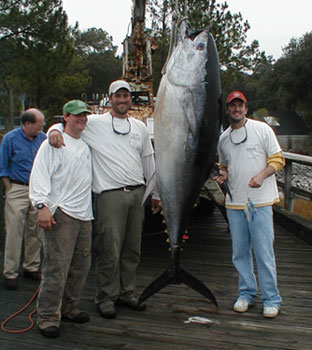
The new South Carolina Bluefin record of 396 pounds.
As recently as last weekend, large schools of bluefin were reported at some of the Georgia Naval Towers, specifically R6 and R7. If last year was any indication, the cooler the water gets, the closer in the tuna will come. The water is still relatively warm for this time of year (if you call 60 degree water warm...), so they'll probably still hang out at the towers for awhile.
When choosing tackle for these bruisers, keep in mind that they average over 100 pounds, even in this area. A metal framed 50-class reel or bigger is a must, spooled with 60-100 pound test monofilament. Anything less will simply not cut it. A big tuna can crack the frame on any cheaply made or graphite frame reel. If you want to fight it standing up, an 80-130 pound class rod is needed, the shorter the better. A 5'6" rod is normal. If using a fighting chair a longer (6'6"-7'), lighter rod is best, usually in the 50-80 pound class range.
Bluefin take both live and dead trolled baits. Big ballyhoo or bonita with colorful skirts covering the nose are great choices. When using artificials, big cedar tuna plugs are the best go-to bait, but artificial ballyhoo, bonita, or big trolling lures with chugger heads will do the trick.
When you do hook up with one, be prepared for a long battle with many runs and deep dives. Whatever you do, though, do not let the fish go too deep for too long. Bluefin often sound to the depths and die, leaving you with a couple hundred pounds of dead weight to haul straight up. It is much easier to bring a live, willing 300 pound tuna to the boat than a 100 pound dead tuna on the bottom. Also make sure to have several helping hands onboard when you bring the fish to the boat. A very heavy gaff is needed to haul a fish this size onto the boat, as well as 2-3 bodies to heave it over the gunwhales.
Bluefin fishing is not for beginners. you need an experienced captain and a good boat that can handle the rough seas this time of year. However, the effort is worth the reward, because bluefin really are the only huge pelagic species that the average Low Country day-tripper has a shot at. Marlin, sailfish, and wahoo confine themselves to the Gulfstream waters for the most part, but you can be tangling with a 300+ pound tuna only a few minutes offshore!
