
After large spring tides the past few days, water levels are finally dropping to ideal fishing levels and the water continues to clear up. Redfish and trout were biting well before the big tides. Last Tuesday I had an opportunity to fish with Capt. Roger Straight and we had a very good day. We fished the Wassaw Sound area, leaving at low tide. After only a few hours we limited out on redfish and then some. Between three of us, we caught 25 spottails with only 3 under the limit size. I caught one 20 inch red and Capt. Roger caught a 22 1/2 inch stag bass. When the tide got higher, we tried another drop for trout. We caught only 6 trout, but Capt. Roger caught a 21 inch gator trout. It was an awesome day and we each returned home with our 5-fish limit.
Most of the fish were caught on live shrimp under popping corks. Bait shrimp supplies are spotty. Some places report large quantities of local shrimp, while other are starting to import live shrimp from Florida. As the shrimp population dwindles, it is time to start switching to artificial baits. However, redfish, seatrout, flounder, and sheepshead are all biting very well right now.
Wednesday, November 28, 2007


Thursday, November 15, 2007
Sea School Captain's License Course
Sea School, the nation's #1 captain's license instructor, will be holding its course series for the area coming next month. The Savannah course (GA 6-pack license) begins December 1st and the Bluffton course (SC license) begins December 8th. Courses will also be held in Charleston twice a month. The course is $550 the week of the course, but if you sign up early it is reduced to $495. If you've got the know-how and plenty of on-the-water experience, this is a great opportunity to make some money off of your favorite hobby!
Also, as a reminder, try out the new message forum we have under construction.
Also, as a reminder, try out the new message forum we have under construction.
Wednesday, November 14, 2007
New Shimano Reel Technology
Video outlining the features in Shimano's reinvented spinning reel lineup.
On a side note: here's an early look at the forum I'm building for the site. Feel free to sign up and post. We'll call it version 0.9.
On a side note: here's an early look at the forum I'm building for the site. Feel free to sign up and post. We'll call it version 0.9.
Redfish Stocking Pays Off
Two years ago, Georgia Department of Natural Resources started on a project called the Peach State Reds Initiative. It is an ongoing study to test the viability of a large-scale redfish stocking program on the Georgia coast. They released 500,000 1 to 2 inch fingerling redfish into the Wassaw Sound estuary.
Now those little ones have gotten big enough to keep, and the results have been astounding. This is the best fall season I've ever seen in terms of shear numbers of 2nd-year fish. Everyone I've talked to who fishes the Wassaw Sound area agrees with me. All the fish seem to be between 14 and 20 inches, which would suggest that many of these are stocked fish that have grown up and remained in the area. The only way to be sure is through genetic testing for DNA markers. This is done by submitting fin clippings to DNR for testing. As of right now only licensed charter guides in the area have the DNR fin-clip kits. However, they will soon be available to the public.

I doubt we'll have to wait until the study concludes in 2009 to come to a consensus on the program's success. If you want to do your own "redfish sampling" the main baits they are biting right now are shrimp- either live or artificial. I've had some incredible success with the Gulp! Alive shrimp baits for redfish- especially in the Pearl White color. I've been slowly bouncing them on the bottom with a 1/4 ounce jighead around structure. These baits, while a bit expensive, do seem to work better than live bait at times. Plus, one Gulp! shrimp will catch 3-4 fish, whereas it seems like it takes 2 live shrimp to catch 1 fish.
The rest of the fall fishing bunch are out in force as well. Seatrout, flounder, and sheepshead are all making a strong showing right now.
Now those little ones have gotten big enough to keep, and the results have been astounding. This is the best fall season I've ever seen in terms of shear numbers of 2nd-year fish. Everyone I've talked to who fishes the Wassaw Sound area agrees with me. All the fish seem to be between 14 and 20 inches, which would suggest that many of these are stocked fish that have grown up and remained in the area. The only way to be sure is through genetic testing for DNA markers. This is done by submitting fin clippings to DNR for testing. As of right now only licensed charter guides in the area have the DNR fin-clip kits. However, they will soon be available to the public.
I doubt we'll have to wait until the study concludes in 2009 to come to a consensus on the program's success. If you want to do your own "redfish sampling" the main baits they are biting right now are shrimp- either live or artificial. I've had some incredible success with the Gulp! Alive shrimp baits for redfish- especially in the Pearl White color. I've been slowly bouncing them on the bottom with a 1/4 ounce jighead around structure. These baits, while a bit expensive, do seem to work better than live bait at times. Plus, one Gulp! shrimp will catch 3-4 fish, whereas it seems like it takes 2 live shrimp to catch 1 fish.
The rest of the fall fishing bunch are out in force as well. Seatrout, flounder, and sheepshead are all making a strong showing right now.
Friday, June 22, 2007
Hot Beach Nightlife Season
With much of the inshore action slowing for the hot summer months, and if you want to get your saltwater fix without going offshore, this is a great time to head to the beach. However, during the day it can be close quarters sharing the beach with tourists and swimmers, and on the piers it is elbow-to-elbow. What most people don't know is that when temps approach 100 degrees in the daytime, the best time to fish is at night. From 6 PM to 10 AM is the best window for summer surf fishing. A nocturnal angler can expect to see Spanish Mackeral, seatrout, whiting, weakfish, flounder, black drum, bluefish, pompano, and sharks, sharks, and more sharks.

There is really something for everybody in the surf at night. From those who use light setups to throw artificials for Spanish Mackeral and seatrout, to medium live-bait rigs for bluefish, whiting, and black drum, to heavy surf-casting or standup gear to tangle with big sharks.
For those who prefer light setups, I prefer a 7-foot medium to medium heavy spinning rod with a 2500 t0 4000 size spinning reel spooled with 12 pound mono or 20 pound braid. If you throw artificials, I recommend using a 2 foot flourocarbon leader of 20 -pound test. As far as baits, casting spoons, artificial jigs, a jighead with a live shrimp, or a Gotcha plug (seen below) will do the ticket. Gotcha plugs are especially effective on Bluefish and Spanish Mackeral when retrieved very, very quickly.

Surf fishing for big sharks is a whole new ballgame, and will be the subject of the next entry.
Wednesday, June 13, 2007
Slow Fishing on the Saltwater Side
It's been awhile since my last post, but things have been busy, and until recently, the fishing had been good. However since Tropical Storm Barry blew through things have been quite rough. The large roe seatrout have been spotty at best, and the odd redfish might only be found on a high tide in the grass. Heavy rain, though a blessing for farmers and landscapers alike, has made the water quite muddy. Even offshore, the greenwater extends out almost to the Navy towers.
Captain Johnny of Amick's Deep Sea Charters said that this is one of the toughest years they have ever had bottom fishing. The big red snapper and grouper are few and far between, and it is a struggle to limit out on even beeliners. They have had very consistent bites, though, from amberjack and dolphin. Mike Argenta, Assistant Store Manager at Bass Pro Shops, was fishing in 300 feet of water Sunday and caught a surprising amount of kings for that depth. The dolphin bite was hot, too, and they broke off a decent tuna. Cobia fishing in the Broad River and offshore continues to be good as well. A couple of reports of tarpon have been filtering in from the Brunswick area as the tarpon season gets a good jumpstart. Hopefully this year will be much better than last year's lackluster performance from the silver kings.
Surf fishing has been hit-and-miss. Whiting and bluefish are biting well, and those who fish a live whiting or blue on a wire fishfinder rig might get to tangle with a big blacktip or sand tiger shark. Good seatrout catches have been reported on the beaches using live mud minnows.
Captain Johnny of Amick's Deep Sea Charters said that this is one of the toughest years they have ever had bottom fishing. The big red snapper and grouper are few and far between, and it is a struggle to limit out on even beeliners. They have had very consistent bites, though, from amberjack and dolphin. Mike Argenta, Assistant Store Manager at Bass Pro Shops, was fishing in 300 feet of water Sunday and caught a surprising amount of kings for that depth. The dolphin bite was hot, too, and they broke off a decent tuna. Cobia fishing in the Broad River and offshore continues to be good as well. A couple of reports of tarpon have been filtering in from the Brunswick area as the tarpon season gets a good jumpstart. Hopefully this year will be much better than last year's lackluster performance from the silver kings.
Surf fishing has been hit-and-miss. Whiting and bluefish are biting well, and those who fish a live whiting or blue on a wire fishfinder rig might get to tangle with a big blacktip or sand tiger shark. Good seatrout catches have been reported on the beaches using live mud minnows.
Wednesday, April 11, 2007
Area Fishing Report 4/11
Inshore Report
Despite a recent cold snap, area inshore fishing continues to be strong. Redfish continue to congregate on the mud flats on sunny afternoons, and will take soft plastic jerkbaits, DOA shrimp, live shrimp on a jighead, or Berkley Gulp! shrimp (try the Lime Tiger color). If a strong high tide moves them into the grass try throwing a weedless spoon. Seatrout are still found in deeper water, and will take curl-tail grubs, shad-tail jigs, and of course, shrimp. A few reports of the bigger roe trout are around, but with water temps in the mid-60's it should still be a week or two before they will really show up. On the surf/pier front some bigger whiting are starting to show up, as well as an unusually high number of spot (spotted croaker) catches. A few sharks are showing up, and pompano should start to show up as well as the water nears 70 degrees. Striper fishing in the Savannah and Ogeechee rivers is starting to wind down, but there are probably still a few around that will hit mullet or mud minnows.
Offshore Report
There have been some amazing black seabass catches lately on the nearshore wrecks and artificial reefs. Some boats are limiting out just a few minutes after arriving at the fishing grounds. Red snapper and grouper catches have started to improve as the bottom fishing season ramps up. One lucky angler fishing on Steve Amick's Scat II caught a nice red snapper in the 16-20 pound range at the Snapper Banks on March 31st: a nice catch so early in the season. On the trolling front, the water is still a little too chilly for the big kings to show up, but a few early runners might be around. Some outstanding reports of wahoo have been coming in from the Stream, and guys have been catching them on ballyhoo with hair-skirted Islanders or other teasers over the nose.
Despite a recent cold snap, area inshore fishing continues to be strong. Redfish continue to congregate on the mud flats on sunny afternoons, and will take soft plastic jerkbaits, DOA shrimp, live shrimp on a jighead, or Berkley Gulp! shrimp (try the Lime Tiger color). If a strong high tide moves them into the grass try throwing a weedless spoon. Seatrout are still found in deeper water, and will take curl-tail grubs, shad-tail jigs, and of course, shrimp. A few reports of the bigger roe trout are around, but with water temps in the mid-60's it should still be a week or two before they will really show up. On the surf/pier front some bigger whiting are starting to show up, as well as an unusually high number of spot (spotted croaker) catches. A few sharks are showing up, and pompano should start to show up as well as the water nears 70 degrees. Striper fishing in the Savannah and Ogeechee rivers is starting to wind down, but there are probably still a few around that will hit mullet or mud minnows.
Offshore Report
There have been some amazing black seabass catches lately on the nearshore wrecks and artificial reefs. Some boats are limiting out just a few minutes after arriving at the fishing grounds. Red snapper and grouper catches have started to improve as the bottom fishing season ramps up. One lucky angler fishing on Steve Amick's Scat II caught a nice red snapper in the 16-20 pound range at the Snapper Banks on March 31st: a nice catch so early in the season. On the trolling front, the water is still a little too chilly for the big kings to show up, but a few early runners might be around. Some outstanding reports of wahoo have been coming in from the Stream, and guys have been catching them on ballyhoo with hair-skirted Islanders or other teasers over the nose.
Friday, March 30, 2007
Spring Bass Fever
There's nothing more fun, or aggrevating, for a bass fisherman than spotting a big bass sitting on a bed and trying to entice it into eating. Some bass are very territorial and will strike intruding lures with abandon. Others will sit motionless, or aimlessly nose at the offending intruder until it leaves the bed. I've seen some anglers, myself included, who will work a bed tirelessly for up to an hour trying to work such timid bass into such a frenzy that it will finally take our offering. Often, said anglers go home fuming mad and empty handed.
This is the story of spring bass bed fishing. A lot of the ponds and lakes which I bass fish in have very clear water in them that make it conducive to sight fishing the beds, and I've picked up a few things along the way. If you follow this set of steps, you should be able to catch almost any fish off the bed.
Step One - Gear Up
Having the right gear and lures will go a long way. Because bed fishing is usually done in shallow, clear water, I highly recommend flourocarbon line. Its low visibility is a must for finicky bass, and its low stretch means a quick, hard hookset. For a rod I recommend that you have one medium-heavy action casting and one medium-heavy spinning rod. The spinning rod will be used for casting weightless plastics.
You'll want a good assortment of baits, but here are the key ones: lizards, senko-type wacky worms, finesse or trick worms, creature or crawfish baits, jigs, spinnerbaits, and lipless crankbaits. You'll also want some different sizes of worm weights.
Step Two - Locate the Bed
Here's where a pair of polarized sunglasses will go a long way. They will alow you to cut through the glare on the water's surface and spot the fish on the bed. It can sometimes take a trained eye to notice a bass, as they can blend in with the bottom cover surprisingly well. Take your time when working a bank, as the slightest movement can clue you into a bass' location. Also, keep in mind that bass tend to prefer to make their beds in shallow, open water with sandy bottom and lots of sunlight.
Step Three - Male or Female?
This is an important step in determining how to work the bed. Usually a bed will have 2 to 3 fish in the immediate area: a female and one or two males. Differentiating the two is fairly easy. Males tend to be smaller, and more aggressive. They will cirle around and over the bed, chasing away bream and other egg-stealers that get near the bed. Females, however, are usually much larger and will be suspended either over the bed or nearby, moving very little. Most people's first instinct is to go for the big female first, but it is usually a good idea to target the male first. The male is aggressive anyway, and you are more likely to catch him. Plus if you are working a lure near the female, and the aggressive male comes up and snatches it, the female can be spooked and swim off.
Step Four - Wacky Worm
While most people will grab a lizard or flipping bait for a bed first, I will always toss a wacky-rigged worm in first to test the waters. Often the aggressive males will snap up a wacky-rigged senko or finesse worm as soon as it enters the general area of the bed. This is often proves a much quicker way to catch fish then working the bed itself. If the fish have lockjaw, then move on to the next step.
Step 5 - Here, Lizard, Lizard...
If you make it to this step without ctaching the male, it means he is a little more focused on defending the bed itself, and you'll need to attack it directly with a bass' most hated foe: the bed-thieving salamander. Rig a small 4-5 inch lizard with a light screw-in weight and a large offset hook. When I say large, I mean that it is so big that it barely fits the body. I will explain this in a moment.
Toss the lizard just beyond the bed and let it go to the bottom. Now sloooowly drag the lizard into the bed and stop. By this time, you'll usually have a fish's attention. If he comes and looks at the lizard, but doesn't pick it up, start nugging the lizard's head up and down very subtly without moving it forward. If it doesn't pick up the lizard right away, be patient, keep doing this for a few minutes and the male will eventually pick it up.
Once the lizard is in the bass' mouth, you have to be quick. Often, the male will pick the lizard up by just the tail and spit out the lure outside the bed. This is where the big hook comes in. Set the hook hard once you see he has it and get the bass out of the water as quickly as possible to avoid spooking the female. If you're releasing the fish, do it away from the female.
If the lizard doesn't work, try alternatives like crawfish baits and jigs.
Step Six - Make Mama Mad
Female bass on beds are notoriously lockjawed. Really the only way to make them bite is to make them mad. Nothing does this better than a lipless crankbait like a Rat-L-Trap. Alternatively, a spinnerbait with colorado blades will work as well. Throw it out far beyond the female and rip it back quickly, running it in front of her face. Always keep the bait in front of the bass, because nothing will spook it quicker than having a bait run right up behind it. Make many, many casts until you make the bass mad. It seems to the bass like an invading bream that's trying to dart into the bed. Eventually, the bass will get angry and start to take swipes at the crankbait, so be ready to set the hook.
Patience is key when fishing a bed. It is easy to get mad when you see a bass interested in your lure, but it just won't take it. Don't start switching from bait to bait trying to find the golden ticket. Stick to a few baits and patterns and keep working them. Eventually, the bass will show enough interest in the bait to take a bite, so keep your cool.
Russo's Seafood Restaurant
I had the pleasure of eating at the new restuarant adjacent to Russo's Seafood in Savannah a couple of week ago and I was very impressed. While there has been a controversy over the dine-in tables inside, I chose to eat out on the porch anyway to enjoy the nice spring weather. My family's been getting our fresh seafood from Russo's since before I was born, and I had high expectations. They did not disappoint and exceeded my expectations.
I had a cup of crab stew and a fried oyster po-boy, and both were by far the best I've ever had. The crab stew contained whole lump crab meat and was very rich and flavorful. I've been eating Savannah crab stew for 25 years and I've never had any this good. The oyster po-boy was as good as any oyster house in New Orleans could put out. I could taste fresh saltwater in the oysters and it was obvious they were just a day or two out of the water. It was served with a tangy remoulade sauce, which complimented it very well, and tasty hand-cut french fries.
The service was great and fast, and I was surprised to learn that an old buddy of mine, Kevin, was working the kitchen. Kevin said that business has been great. If they keep up this level of excellance, I can see why. Russo's Seafood Restaurant has definately gone onto my list of great Savannah eateries.
This is the story of spring bass bed fishing. A lot of the ponds and lakes which I bass fish in have very clear water in them that make it conducive to sight fishing the beds, and I've picked up a few things along the way. If you follow this set of steps, you should be able to catch almost any fish off the bed.
Step One - Gear Up
Having the right gear and lures will go a long way. Because bed fishing is usually done in shallow, clear water, I highly recommend flourocarbon line. Its low visibility is a must for finicky bass, and its low stretch means a quick, hard hookset. For a rod I recommend that you have one medium-heavy action casting and one medium-heavy spinning rod. The spinning rod will be used for casting weightless plastics.
You'll want a good assortment of baits, but here are the key ones: lizards, senko-type wacky worms, finesse or trick worms, creature or crawfish baits, jigs, spinnerbaits, and lipless crankbaits. You'll also want some different sizes of worm weights.
Step Two - Locate the Bed
Here's where a pair of polarized sunglasses will go a long way. They will alow you to cut through the glare on the water's surface and spot the fish on the bed. It can sometimes take a trained eye to notice a bass, as they can blend in with the bottom cover surprisingly well. Take your time when working a bank, as the slightest movement can clue you into a bass' location. Also, keep in mind that bass tend to prefer to make their beds in shallow, open water with sandy bottom and lots of sunlight.
Step Three - Male or Female?
This is an important step in determining how to work the bed. Usually a bed will have 2 to 3 fish in the immediate area: a female and one or two males. Differentiating the two is fairly easy. Males tend to be smaller, and more aggressive. They will cirle around and over the bed, chasing away bream and other egg-stealers that get near the bed. Females, however, are usually much larger and will be suspended either over the bed or nearby, moving very little. Most people's first instinct is to go for the big female first, but it is usually a good idea to target the male first. The male is aggressive anyway, and you are more likely to catch him. Plus if you are working a lure near the female, and the aggressive male comes up and snatches it, the female can be spooked and swim off.
Step Four - Wacky Worm
While most people will grab a lizard or flipping bait for a bed first, I will always toss a wacky-rigged worm in first to test the waters. Often the aggressive males will snap up a wacky-rigged senko or finesse worm as soon as it enters the general area of the bed. This is often proves a much quicker way to catch fish then working the bed itself. If the fish have lockjaw, then move on to the next step.
Step 5 - Here, Lizard, Lizard...
If you make it to this step without ctaching the male, it means he is a little more focused on defending the bed itself, and you'll need to attack it directly with a bass' most hated foe: the bed-thieving salamander. Rig a small 4-5 inch lizard with a light screw-in weight and a large offset hook. When I say large, I mean that it is so big that it barely fits the body. I will explain this in a moment.
Toss the lizard just beyond the bed and let it go to the bottom. Now sloooowly drag the lizard into the bed and stop. By this time, you'll usually have a fish's attention. If he comes and looks at the lizard, but doesn't pick it up, start nugging the lizard's head up and down very subtly without moving it forward. If it doesn't pick up the lizard right away, be patient, keep doing this for a few minutes and the male will eventually pick it up.
Once the lizard is in the bass' mouth, you have to be quick. Often, the male will pick the lizard up by just the tail and spit out the lure outside the bed. This is where the big hook comes in. Set the hook hard once you see he has it and get the bass out of the water as quickly as possible to avoid spooking the female. If you're releasing the fish, do it away from the female.
If the lizard doesn't work, try alternatives like crawfish baits and jigs.
Step Six - Make Mama Mad
Female bass on beds are notoriously lockjawed. Really the only way to make them bite is to make them mad. Nothing does this better than a lipless crankbait like a Rat-L-Trap. Alternatively, a spinnerbait with colorado blades will work as well. Throw it out far beyond the female and rip it back quickly, running it in front of her face. Always keep the bait in front of the bass, because nothing will spook it quicker than having a bait run right up behind it. Make many, many casts until you make the bass mad. It seems to the bass like an invading bream that's trying to dart into the bed. Eventually, the bass will get angry and start to take swipes at the crankbait, so be ready to set the hook.
Patience is key when fishing a bed. It is easy to get mad when you see a bass interested in your lure, but it just won't take it. Don't start switching from bait to bait trying to find the golden ticket. Stick to a few baits and patterns and keep working them. Eventually, the bass will show enough interest in the bait to take a bite, so keep your cool.
Russo's Seafood Restaurant
I had the pleasure of eating at the new restuarant adjacent to Russo's Seafood in Savannah a couple of week ago and I was very impressed. While there has been a controversy over the dine-in tables inside, I chose to eat out on the porch anyway to enjoy the nice spring weather. My family's been getting our fresh seafood from Russo's since before I was born, and I had high expectations. They did not disappoint and exceeded my expectations.
I had a cup of crab stew and a fried oyster po-boy, and both were by far the best I've ever had. The crab stew contained whole lump crab meat and was very rich and flavorful. I've been eating Savannah crab stew for 25 years and I've never had any this good. The oyster po-boy was as good as any oyster house in New Orleans could put out. I could taste fresh saltwater in the oysters and it was obvious they were just a day or two out of the water. It was served with a tangy remoulade sauce, which complimented it very well, and tasty hand-cut french fries.
The service was great and fast, and I was surprised to learn that an old buddy of mine, Kevin, was working the kitchen. Kevin said that business has been great. If they keep up this level of excellance, I can see why. Russo's Seafood Restaurant has definately gone onto my list of great Savannah eateries.
Tuesday, March 27, 2007
...Out Like A Lamb
A predictable March comes to a close as a pleasant, if somewhat warmer than usual, spring pattern emerges. This is a great time to go fishing, freshwater or saltwater, so you really should get out there.
Whiting Bite
Now is a great time to be a pier or surf fisherman. With rising water temps in the mid-60s, the annual run of fillet-sized whiting has started. Good catches of large whiting have been reported recently, and they should only get better going into April. The whiting bite will continue to be good until the water temps hit the mid to upper 70s, when toothy predators, namely sharks, bluefish, and spanish mackeral, will have these tasty little morsels seeking refuge elsewhere.
Not many people realize this, but there are actually two species of whiting. The southern whiting (also called kingfish, not to be confused with king mackeral) is the smaller breed which shows up first and tends to have a lighter color that runs from pink to silver and gold. The northern whiting tends to show up a little later and has a darker, striped pattern of bars in black, purple, or brown. Both are very tasty with light, flaky meat that rivals seatrout and sheepshead. However, their small size limits the size of the fillets.
What whiting lack in size, though, they make up for in numbers and "catchability." Whiting fishing is a great way to introduce kids or landlubbers to saltwater fishing. All you need is a light bottom rig, a couple of small hooks, and some fresh dead shrimp. However, there are a number of secrets to whiting fishing that can turn you into the whiting king of the pier. I normally either tie my own leaders or use a premade pompano/whiting two-hook bottom rig. A 1 to 3 ounce pyramid sinker is sufficient for most current, and make sure to use gold or red hooks. Something about those colors catch the whiting's eye, and I've had whiting bite bare gold hooks before.
A long, limber graphite rod is the best way to go for whiting. You'll see a lot of people using heavy fiberglass rods at the pier or on the beach for whiting, but this is overkill and takes all the fun out of catching them. The limber graphite rod picks up the subtle whiting bite a lot better then a cheap fiberglass rod does, and you'll have people on the pier wondering what you are doing differently when you are hooking up with more fish.
The best secret about whiting fishing is the bait. Fresh-dead local shrimp are by far better than frozen Chinese pond-raised shrimp. Peel them and cut them into two halves. Using smaller pieces will coax the whiting into eating instead of tearing pieces off of a whole shrimp. Peeled shrimp also tend to stay on the hook longer, as whiting will suck the meat out of a shrimp with a shell on. Whiting tend to school and feed during tide changes, either as the tide starts to come in or just as it starts to go out, so try to schedule accordingly if you want to go after them.
Go To Bed
It's that time again this year to fish for bass on the beds. That means sight fishing and flipping baits like lizards and craws. Spring is also a great time for spinnerbaits and wacky worming as well. Check back for a full post next time on springtime bass fishing.
Whiting Bite
Now is a great time to be a pier or surf fisherman. With rising water temps in the mid-60s, the annual run of fillet-sized whiting has started. Good catches of large whiting have been reported recently, and they should only get better going into April. The whiting bite will continue to be good until the water temps hit the mid to upper 70s, when toothy predators, namely sharks, bluefish, and spanish mackeral, will have these tasty little morsels seeking refuge elsewhere.
Not many people realize this, but there are actually two species of whiting. The southern whiting (also called kingfish, not to be confused with king mackeral) is the smaller breed which shows up first and tends to have a lighter color that runs from pink to silver and gold. The northern whiting tends to show up a little later and has a darker, striped pattern of bars in black, purple, or brown. Both are very tasty with light, flaky meat that rivals seatrout and sheepshead. However, their small size limits the size of the fillets.
What whiting lack in size, though, they make up for in numbers and "catchability." Whiting fishing is a great way to introduce kids or landlubbers to saltwater fishing. All you need is a light bottom rig, a couple of small hooks, and some fresh dead shrimp. However, there are a number of secrets to whiting fishing that can turn you into the whiting king of the pier. I normally either tie my own leaders or use a premade pompano/whiting two-hook bottom rig. A 1 to 3 ounce pyramid sinker is sufficient for most current, and make sure to use gold or red hooks. Something about those colors catch the whiting's eye, and I've had whiting bite bare gold hooks before.
A long, limber graphite rod is the best way to go for whiting. You'll see a lot of people using heavy fiberglass rods at the pier or on the beach for whiting, but this is overkill and takes all the fun out of catching them. The limber graphite rod picks up the subtle whiting bite a lot better then a cheap fiberglass rod does, and you'll have people on the pier wondering what you are doing differently when you are hooking up with more fish.
The best secret about whiting fishing is the bait. Fresh-dead local shrimp are by far better than frozen Chinese pond-raised shrimp. Peel them and cut them into two halves. Using smaller pieces will coax the whiting into eating instead of tearing pieces off of a whole shrimp. Peeled shrimp also tend to stay on the hook longer, as whiting will suck the meat out of a shrimp with a shell on. Whiting tend to school and feed during tide changes, either as the tide starts to come in or just as it starts to go out, so try to schedule accordingly if you want to go after them.
Go To Bed
It's that time again this year to fish for bass on the beds. That means sight fishing and flipping baits like lizards and craws. Spring is also a great time for spinnerbaits and wacky worming as well. Check back for a full post next time on springtime bass fishing.
Friday, March 09, 2007
In Like A Lion...
March Madness
Global warming be damned, March weather is as predictable as the tides. If you are an inshore fisherman this most bipolar of months can give you fits. The pattern is always the same: A day or two of cold, drenching rains followed by several days of bluebird skies and driving winds. If we're lucky we'll get one nice, calm day before the cycle starts over again, and all this is compounded by extremely muddy water. A true angler can't pick his days, so finding schooling fish is the key to making the most of March weather.
High Tide
Gimme Shelter
When the wind starts to blow with a vengeance, most folks have a sheltered spot in mind that they automatically run to. While this may make things more comfortable for you, it usually will end up to be a very slow day of fishing. Predators like spottails and seatrout love windy, muddy, choppy water because it gives them an edge. They can sneak up on bait without being seen or heard, and can also escape larger predators that may want to make a meal of them. With low numbers of shrimp in inshore waters, the main baits this time of year for inshore gamefish are mudminnows, mullet, pinfish, and other small baitfish. At high tide, they'll charge into marsh creeks seeking cleaner water and shelter from the wind. Consequently, the best spots are transition points where choppy, turbid water feeds into quiet, secluded areas.
A soft paddletail or grub bait on a heavy jig head worked on the bottom is a good choice. If possible, cast into the wind and upcurrent, working the jig back to the boat with the current. Seatrout and spottails will face upcurrent and upwind to ambush any bait floating by.
Tailing Flats
Spottails will take the opportunity of flood tides and wind-driven water to dig themselves into the grass flats, particularly on days when the afternoon sun warms up the shallow water. The grass also acts as a filter and the water is often much cleaner than out in the creeks. Weedless jerkbaits or saltwater spinnerbaits will scoot through the grass and will fool spooky reds if you are quiet and careful. The wind can actually be an ally in this environment, as it can muffle your approach while the spottails are busy rooting around in the mud bottom.
Low Tide
With no grass or sheltered holes to hide in at low tide, bait will have to move out into the larger rivers and even into the sounds. Baitfish will stay constantly on the move at low tide, so you might have to follow their movement. Muddy water means that spottails and trout have less to worry about from hungry porpoises in the sounds, so shell banks and oyster reefs adjacent to deep water will hold fish. However, as the tide changes, the fish will move back to the feeder creek mouths to greet the rush of bait back into the marshes. The good news about low tide is that mud banks which were underwater at high tide are now wind breaks.
Global warming be damned, March weather is as predictable as the tides. If you are an inshore fisherman this most bipolar of months can give you fits. The pattern is always the same: A day or two of cold, drenching rains followed by several days of bluebird skies and driving winds. If we're lucky we'll get one nice, calm day before the cycle starts over again, and all this is compounded by extremely muddy water. A true angler can't pick his days, so finding schooling fish is the key to making the most of March weather.
High Tide
Gimme Shelter
When the wind starts to blow with a vengeance, most folks have a sheltered spot in mind that they automatically run to. While this may make things more comfortable for you, it usually will end up to be a very slow day of fishing. Predators like spottails and seatrout love windy, muddy, choppy water because it gives them an edge. They can sneak up on bait without being seen or heard, and can also escape larger predators that may want to make a meal of them. With low numbers of shrimp in inshore waters, the main baits this time of year for inshore gamefish are mudminnows, mullet, pinfish, and other small baitfish. At high tide, they'll charge into marsh creeks seeking cleaner water and shelter from the wind. Consequently, the best spots are transition points where choppy, turbid water feeds into quiet, secluded areas.
A soft paddletail or grub bait on a heavy jig head worked on the bottom is a good choice. If possible, cast into the wind and upcurrent, working the jig back to the boat with the current. Seatrout and spottails will face upcurrent and upwind to ambush any bait floating by.
Tailing Flats
Spottails will take the opportunity of flood tides and wind-driven water to dig themselves into the grass flats, particularly on days when the afternoon sun warms up the shallow water. The grass also acts as a filter and the water is often much cleaner than out in the creeks. Weedless jerkbaits or saltwater spinnerbaits will scoot through the grass and will fool spooky reds if you are quiet and careful. The wind can actually be an ally in this environment, as it can muffle your approach while the spottails are busy rooting around in the mud bottom.
Low Tide
With no grass or sheltered holes to hide in at low tide, bait will have to move out into the larger rivers and even into the sounds. Baitfish will stay constantly on the move at low tide, so you might have to follow their movement. Muddy water means that spottails and trout have less to worry about from hungry porpoises in the sounds, so shell banks and oyster reefs adjacent to deep water will hold fish. However, as the tide changes, the fish will move back to the feeder creek mouths to greet the rush of bait back into the marshes. The good news about low tide is that mud banks which were underwater at high tide are now wind breaks.
Saturday, February 03, 2007
Winter Seatrout
February is a hard month to fish. When it's not raining, or the wind isn't blowing up a gale, it is bitterly cold. However, that doesn't mean that the fish aren't there. Seatrout and many other species live their lives regionally, meaning they don't migrate down the coast in search of warmer water like others do. Most seatrout don't venture more than 40 miles from where they are born. So even in the dead of winter the fish are out there, hunkered down, and if you're lucky they might just be hungry.
Seatrout like to move farther up into the estuary during the winter. This means you'll find them away from the sounds and beaches, farther up in the tidal creeks and rivers. This is likely due to the clear water during the winter. When the water is cold and clear, porpoises, dolphins, and other large predators can roam the beaches and bays without having to compete with sharks. This causes the seatrout to seek refuge in the tidal creeks, where they are also after the smaller baitfish that have found shelter as well. With the seasonal depature of most shrimp from the area, mullet, mud minnows, and killifish are the main forage of the trout.
The trout will always congregate to the warmest water available. This usually means deep holes where small creeks dump into rivers, or depressions around structure like bridge pilings. The difference between a spot devoid of fish and a spot full of fish can be one degree of water temperature.
This is why reports are so varied this time of year. One guy gets skunked while another guy catches a limit of nice trout. What did the lucky guy do differently? He found a warmer hole where the fish were stacked up. I have had many a winter day where I'll fish a spot and limit out on trout, only to go without a single bite the next.
Artificial baits are the name of the game in winter. A shad-tail jig like the Sea Assassin or a curly-tail grub are good bets. The salt-and-pepper w/chartreuse tail color is my favorite go-to bait. Many folks will tell you to try the Electric Chicken color, but try something different. I have caught many more trout on other colors than "The Chicken" than I ever have with it. Use them on a 1/4 ounce jighead, which is enough weight to get the bait down to the bottom where the fish are usually holding.
Fake pre-rigged shrimp are also a nice choice this time of year, if you know how to use them. The DOA shrimp or Offshore Angler Shiner Shrimp are the best two on the market. On a high tide, these are great thrown up into the grass when trout and redfish move onto the flood flats. At low tide, find the deepest hole possible, or use them around dock and bridge pilings. No matter where you are fishing them, fish them is slooooooooooow. I can't tell you how many people say these shrimp don't work who are simply using them wrong. Throw it out, and let it sink to the bottom. If you aren't on the bottom, then you won't catch fish. Once there, make very slight twitches with your rod tip, then let it sink back down and sit for 10 seconds or so. Repeat all the way back to your boat. Fish get lazy when the water is cold, so they want a simple meal. A slow-moving shrimp sitting on the bottom is something that no trout can resist. If you haven't gotten a bite after about 10 casts or so, you're in the wrong spot. I've found that the best colors depend on water clarity. In clear water, a clear w/red glitter seems to work great. In stained water, or at night under a dock light, the glow color is best. In very muddy water, the rootbeer w/gold flake seems to be the only one that works.
For guys who absolutely insist on using live bait, mud minnows or small finger mullet under a popping cork can work wonders on a slow winter day.
This time of the year is a great opportunity to enjoy the area's fishery without much pressure from other anglers and boaters. On cold days in February you'll be lucky to see another boat. Those guys who wait until warmer weather, though, are missing out on some great seatrout fishing.
Seatrout like to move farther up into the estuary during the winter. This means you'll find them away from the sounds and beaches, farther up in the tidal creeks and rivers. This is likely due to the clear water during the winter. When the water is cold and clear, porpoises, dolphins, and other large predators can roam the beaches and bays without having to compete with sharks. This causes the seatrout to seek refuge in the tidal creeks, where they are also after the smaller baitfish that have found shelter as well. With the seasonal depature of most shrimp from the area, mullet, mud minnows, and killifish are the main forage of the trout.
The trout will always congregate to the warmest water available. This usually means deep holes where small creeks dump into rivers, or depressions around structure like bridge pilings. The difference between a spot devoid of fish and a spot full of fish can be one degree of water temperature.
This is why reports are so varied this time of year. One guy gets skunked while another guy catches a limit of nice trout. What did the lucky guy do differently? He found a warmer hole where the fish were stacked up. I have had many a winter day where I'll fish a spot and limit out on trout, only to go without a single bite the next.
Artificial baits are the name of the game in winter. A shad-tail jig like the Sea Assassin or a curly-tail grub are good bets. The salt-and-pepper w/chartreuse tail color is my favorite go-to bait. Many folks will tell you to try the Electric Chicken color, but try something different. I have caught many more trout on other colors than "The Chicken" than I ever have with it. Use them on a 1/4 ounce jighead, which is enough weight to get the bait down to the bottom where the fish are usually holding.
Fake pre-rigged shrimp are also a nice choice this time of year, if you know how to use them. The DOA shrimp or Offshore Angler Shiner Shrimp are the best two on the market. On a high tide, these are great thrown up into the grass when trout and redfish move onto the flood flats. At low tide, find the deepest hole possible, or use them around dock and bridge pilings. No matter where you are fishing them, fish them is slooooooooooow. I can't tell you how many people say these shrimp don't work who are simply using them wrong. Throw it out, and let it sink to the bottom. If you aren't on the bottom, then you won't catch fish. Once there, make very slight twitches with your rod tip, then let it sink back down and sit for 10 seconds or so. Repeat all the way back to your boat. Fish get lazy when the water is cold, so they want a simple meal. A slow-moving shrimp sitting on the bottom is something that no trout can resist. If you haven't gotten a bite after about 10 casts or so, you're in the wrong spot. I've found that the best colors depend on water clarity. In clear water, a clear w/red glitter seems to work great. In stained water, or at night under a dock light, the glow color is best. In very muddy water, the rootbeer w/gold flake seems to be the only one that works.
For guys who absolutely insist on using live bait, mud minnows or small finger mullet under a popping cork can work wonders on a slow winter day.
This time of the year is a great opportunity to enjoy the area's fishery without much pressure from other anglers and boaters. On cold days in February you'll be lucky to see another boat. Those guys who wait until warmer weather, though, are missing out on some great seatrout fishing.
Saturday, January 20, 2007
Fishing School Workshops
Miss Judy Charters and Capt. Jack McGowan are holding fishing workshops in the coming weeks.
These workshops will be held at Tubby's Tankhouse in Thunderbolt on River Drive. The cost is $90 each, but breakfast and lunch are included. Capt. Jack will be holding a workshop on inshore fishing Jan. 27 from 8AM - 2PM. Capt. Judy will hold her offshore seminar on Feb. 3 from 8AM - 2PM. They will cover all the basics, then move into more advanced tips and techniques. This is a great seminar series for beginners who don't know where to start or old salts who need to brush up on the latest gear and techniques.
To sign up call 912-897-4921 or email Miss Judy at fishjudy2@aol.com .
These workshops will be held at Tubby's Tankhouse in Thunderbolt on River Drive. The cost is $90 each, but breakfast and lunch are included. Capt. Jack will be holding a workshop on inshore fishing Jan. 27 from 8AM - 2PM. Capt. Judy will hold her offshore seminar on Feb. 3 from 8AM - 2PM. They will cover all the basics, then move into more advanced tips and techniques. This is a great seminar series for beginners who don't know where to start or old salts who need to brush up on the latest gear and techniques.
To sign up call 912-897-4921 or email Miss Judy at fishjudy2@aol.com .
Tuesday, January 16, 2007
Savannah's Stripers
Savannah has one of the best striped bass fisheries that you've never heard about. Few people realize that you can catch world-class stripers within sight of downtown Savannah, but after several decades of conservation these Dixie linesiders are back in a big way. When you hear people talk about catching 30+ pound stripers, one's mind usually turns to the chilly New England surf. However, the Savannah, Forest, and Ogeechee Rivers routinely turn out monster stripers.

Stripers are, biologically, a very interesting fish. They are native to saltwater, but are highly tolerant to freshwater. So much so, that many reservoirs and lakes now have large populations of stripers that live their entire lives in freshwater. Ocean stripers live mostly in the saltwater until it is time to spawn, when they move into brackish and freshwater estuaries. Georgia's stripers, though (and those of the St. John's River in Florida) have the opposite life cycle. They live mostly upriver in freshwater during the warmer months, and then move into the brackish and saltwater in the winter.
The Savannah River estuary, from roughly the I-95 bridge all the way to Elba Island, is where you can usually find the stripers this time of year. The best spots have deep, vertical structure, which is why the two hottest spots are at the Houlihan Bridge in Port Wentworth and the old tide gates on the Back River behind Hutchinson Island. The pilings act as current breaks which the stripers can hide behind to ambush prey. Old pilings and channel markers along the Port Wentworth docks hold fish, as well as the mouths of old rice canals feeding into the Savannah Wildlife Refuge.
The Savannah River gets most of the fanfare, but the Forest River and Ogeechee also hold good populations of stripers. Again, bridge pilings and rice canal mouths are good striper-holding structure.
Fairly stout tackle is a must, because some of these fish top 50 pounds. Heavy spinning tackle with 30-50 pound braided line is the best way to go. Live bait can be a good choice depending on what's available. When stripers are feeding on the top, a shrimp under a popping cork is a treat for them. When they're on the bottom, which is where they will be most of the time, a livelined finger mullet is the way to go.
Various artificial lures will work for stripers, but perhaps the best two choices are large swimbaits or bucktail jigs.

Swimbaits are soft plastic baitfish-shaped lures that are pre-weighted and hooked. You just tie them on and cast. These are great baits when the stripers are feeding on mullet and pogies, and several companies make imitations of these baits. The new P'nut Bunker from Storm is a pogy imitation that is perfect for stripers. Keep in mind that stripers often hit big baits. Swimbaits 6 inches or larger are readily taken by even small fish. When retrieving, let the bait fall to the bottom, then retrieve it slowly, letting the current give it action. Pause periodically, letting the bait flutter down. This falling action is often what triggers the striper's instinct to feed.

Bucktail jigs are classic lures for stripers that have been used for generations. The best jigs for river fishing are in the 1/2-ounce to 2 ounce range. Large tides combined with increased flow from the dams upriver can make the current very strong in the Savannah River at times. Heavier jigs will help get the bait to the bottom. These are best pitched very tightly to structure. A jig falling vertically along a piling is almost unbearable to some stripers. The best color combos are red and white or chartreuse and white. To increase the action, pin a chartreuse grub trailer or other small soft plastic to the hook. You can also tip the hook with a small strip of mullet or piece of shrimp to sweeten the deal even more.
A good guide is a great thing to have if you want to hunt stripers, but are overwhelmed by the amount of water you need to cover. Contact Capt. Jack and he can get you on top of some of the biggest linesiders in the area.
Good luck!
Stripers are, biologically, a very interesting fish. They are native to saltwater, but are highly tolerant to freshwater. So much so, that many reservoirs and lakes now have large populations of stripers that live their entire lives in freshwater. Ocean stripers live mostly in the saltwater until it is time to spawn, when they move into brackish and freshwater estuaries. Georgia's stripers, though (and those of the St. John's River in Florida) have the opposite life cycle. They live mostly upriver in freshwater during the warmer months, and then move into the brackish and saltwater in the winter.
The Savannah River estuary, from roughly the I-95 bridge all the way to Elba Island, is where you can usually find the stripers this time of year. The best spots have deep, vertical structure, which is why the two hottest spots are at the Houlihan Bridge in Port Wentworth and the old tide gates on the Back River behind Hutchinson Island. The pilings act as current breaks which the stripers can hide behind to ambush prey. Old pilings and channel markers along the Port Wentworth docks hold fish, as well as the mouths of old rice canals feeding into the Savannah Wildlife Refuge.
The Savannah River gets most of the fanfare, but the Forest River and Ogeechee also hold good populations of stripers. Again, bridge pilings and rice canal mouths are good striper-holding structure.
Fairly stout tackle is a must, because some of these fish top 50 pounds. Heavy spinning tackle with 30-50 pound braided line is the best way to go. Live bait can be a good choice depending on what's available. When stripers are feeding on the top, a shrimp under a popping cork is a treat for them. When they're on the bottom, which is where they will be most of the time, a livelined finger mullet is the way to go.
Various artificial lures will work for stripers, but perhaps the best two choices are large swimbaits or bucktail jigs.
Swimbaits are soft plastic baitfish-shaped lures that are pre-weighted and hooked. You just tie them on and cast. These are great baits when the stripers are feeding on mullet and pogies, and several companies make imitations of these baits. The new P'nut Bunker from Storm is a pogy imitation that is perfect for stripers. Keep in mind that stripers often hit big baits. Swimbaits 6 inches or larger are readily taken by even small fish. When retrieving, let the bait fall to the bottom, then retrieve it slowly, letting the current give it action. Pause periodically, letting the bait flutter down. This falling action is often what triggers the striper's instinct to feed.
Bucktail jigs are classic lures for stripers that have been used for generations. The best jigs for river fishing are in the 1/2-ounce to 2 ounce range. Large tides combined with increased flow from the dams upriver can make the current very strong in the Savannah River at times. Heavier jigs will help get the bait to the bottom. These are best pitched very tightly to structure. A jig falling vertically along a piling is almost unbearable to some stripers. The best color combos are red and white or chartreuse and white. To increase the action, pin a chartreuse grub trailer or other small soft plastic to the hook. You can also tip the hook with a small strip of mullet or piece of shrimp to sweeten the deal even more.
A good guide is a great thing to have if you want to hunt stripers, but are overwhelmed by the amount of water you need to cover. Contact Capt. Jack and he can get you on top of some of the biggest linesiders in the area.
Good luck!
Friday, January 12, 2007
Cold Snap Heralds Bluefin Blitz
The last few years have been great seasons for Bluefin Tuna off the Georgia/SC coast. Normally, the bluefin migrate down from the huge fishing area known as the Grand Banks off New England to the Outer Banks each winter. Only a few confused loners normally make it our way. The last few years, though, the entire pod of Bluefin overshot OBX and headed down into our area. A new South Carolina state record of 396 pounds was caught last year just five miles off Hilton Head on the Betsy Ross wreck. This year appears to be shaping up the same way. Early catch reports from North Carolina suddenly ran cold in late December, and reports of the blue monsters have been coming in from this area more frequently.
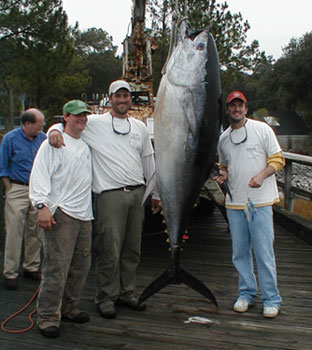
The new South Carolina Bluefin record of 396 pounds.
As recently as last weekend, large schools of bluefin were reported at some of the Georgia Naval Towers, specifically R6 and R7. If last year was any indication, the cooler the water gets, the closer in the tuna will come. The water is still relatively warm for this time of year (if you call 60 degree water warm...), so they'll probably still hang out at the towers for awhile.
When choosing tackle for these bruisers, keep in mind that they average over 100 pounds, even in this area. A metal framed 50-class reel or bigger is a must, spooled with 60-100 pound test monofilament. Anything less will simply not cut it. A big tuna can crack the frame on any cheaply made or graphite frame reel. If you want to fight it standing up, an 80-130 pound class rod is needed, the shorter the better. A 5'6" rod is normal. If using a fighting chair a longer (6'6"-7'), lighter rod is best, usually in the 50-80 pound class range.
Bluefin take both live and dead trolled baits. Big ballyhoo or bonita with colorful skirts covering the nose are great choices. When using artificials, big cedar tuna plugs are the best go-to bait, but artificial ballyhoo, bonita, or big trolling lures with chugger heads will do the trick.
When you do hook up with one, be prepared for a long battle with many runs and deep dives. Whatever you do, though, do not let the fish go too deep for too long. Bluefin often sound to the depths and die, leaving you with a couple hundred pounds of dead weight to haul straight up. It is much easier to bring a live, willing 300 pound tuna to the boat than a 100 pound dead tuna on the bottom. Also make sure to have several helping hands onboard when you bring the fish to the boat. A very heavy gaff is needed to haul a fish this size onto the boat, as well as 2-3 bodies to heave it over the gunwhales.
Bluefin fishing is not for beginners. you need an experienced captain and a good boat that can handle the rough seas this time of year. However, the effort is worth the reward, because bluefin really are the only huge pelagic species that the average Low Country day-tripper has a shot at. Marlin, sailfish, and wahoo confine themselves to the Gulfstream waters for the most part, but you can be tangling with a 300+ pound tuna only a few minutes offshore!
